Free Newsletter

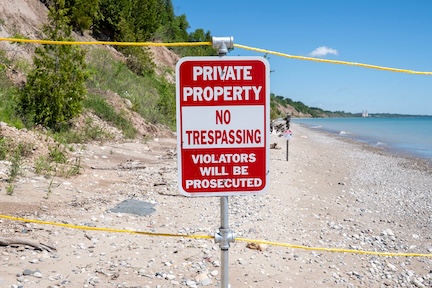
Private property sign on fence guarding private access beach at Lion’s Den Gorge Nature Preserve in Grafton. (USA TODAY Network)
Wisconsin shoreline access dispute reignites in Ozaukee County
USA Today Network//June 18, 2026//


 Listen to this article
IN BRIEF
- Property owners north of Lion’s Den Gorge Nature Preserve erected signs, ropes and cameras restricting beach access.
- Wisconsin law generally allows public access below the ordinary high-water mark under the public trust doctrine.
- A pending Shorewood court case could clarify where public shoreline access ends and private property rights begin.
Debates over public access to the Lake Michigan shoreline are reheating in Ozaukee County after a property owner along the bluff recently drew a line in the sand.
New signage, a roped fence and a trail camera on the beach area extending from homes directly north of the Lion’s Den Gorge Nature Preserve in the Town of Grafton now deter beachgoers from walking north toward an area in the City of Port Washington where a new nature preserve is under development.
Debates over public shoreline access are nothing new for Wisconsin.
But the chatter has been heightened in recent months as a Milwaukee County Circuit Court case, which could make its way to Wisconsin’s Supreme Court, brews in nearby Shorewood.
The Shorewood case and Lion’s Den debates are evidence of the 100-year-old tension between private riparian rights and the rights of the public in navigable waters under Wisconsin’s public trust doctrine.
Landowners and beachgoers may disagree on much, but members of both camps told the Milwaukee Journal Sentinel they want clearer guidance.
Here’s what to know:
What does the law say?
Travis Schroeder, a waterway and wetland field supervisor with Wisconsin’s Department of Natural Resources, said the department fields questions from across the state every year about public vs. private access to shoreline beaches.
He said the public does have the right to cross beaches near private property past what’s called the ordinary high-water mark, meaning the boundary line left by the continuous presence of water, such as a wet mark on the sand, erosion lines or where the sand ends and vegetation begins.
That right was upheld in the 1913 Wisconsin Supreme Court Case Diana Shooting Club v. Husting, according to the WDNR.
Schroeder said a good rule of thumb is to “keep your feet wet.”
But exactly where the ordinary high water mark lands at Lion’s Den appears to be a matter of interpretation at the moment.
Schroeder said the department is working to determine whether the roped off areas north of the Lion’s Den Gorge Nature Preserve are placed correctly, since visitors and beachgoers say they appear to extend past the ordinary high-water mark and into the water.
He said the department is waiting to hear back from property owners to get permission to access the shoreline, and they’d asked some of the landowners to remove any structure extending into the water. They have not gotten a response yet.
A new court case that arose from beaches in Shorewood could add clarity on public vs. private access to beaches
But there’s more than one 100-year-old court case at play, adding more ambiguity.
When Shorewood resident and academic Paul Florsheim was fined $313 for trespassing onto private property by walking above the ordinary high-water mark on a beach in the village, a municipal judge ruled he was guilty, citing the 1923 Wisconsin Supreme Court ruling, Doemel v. Jantz.
The Doemel case, which focused on Lake Winnebago, found that the public trust doctrine does not include the right to walk or stand on the beach between the ordinary high-water mark and the water. But more recent Wisconsin Supreme Court rulings in 2001 (Docks & Slips v. Wisconsin) and 2018 (Movrich v. Lobermeier) found that the state’s ownership of bodies of water and the public trust doctrine both extend public access to from the water’s edge to the ordinary high-water mark.
The Shorewood case garnered attention as Wisconsin’s chance to finally settle the issue of where public access to Lake Michigan ends and where private landowners’ rights begin. The case is scheduled for a hearing in Milwaukee County Circuit Court on Aug. 13.
Neighboring states, like Michigan and Indiana, have already decided the issue in their own Supreme Courts, protecting the right to walk on Great Lakes beaches below the high-water mark.
Property owner says people often misunderstand private property laws
The shoreline home where Mark Harris lives, on one of seven parcels directly north of Lion’s Den, has been in his family for almost 50 years. He moved back there with his wife in June 2025 to help care for his aging mother.
Over the last year, he says he constantly has to clean up trash and dog waste and frequently worries about trespassers and bluff climbers on his beach property. Since the roped fences and cameras surfaced, Harris said he’s also faced disparaging reactions from people, especially on social media.
The signs and ropes the Journal Sentinel photographed on June 12 are not Harris’, but he said he fully agrees with their sentiment.
“We are not trying in any way to take something away from the public that is for the public. We are simply trying to say that the public, unfortunately, has a slight misconception as to what is currently allowed by law,” he said.
Repeatedly, Harris has brought concerns to Ozaukee County officials, including worries about soon being sandwiched between two nature preserves, with the Clay Bluffs Cedar Gorge Nature Preserve under development directly north of the homes.
Harris said he understands the importance of public access to natural spaces, but he feels people should respect private property and they often misunderstand private property laws.
“We want to follow the letter of the law, but some of that, right now, is kind of guided discovery as to what that is,” Harris said.
“As the one sign does say, please feel free to enjoy the half mile of public beach behind you. There’s still beach at the Lion’s Den. It’s still there.”
Lion’s Den visitors think beaches should be accessible to the public
Several visitors to the Lion’s Den the Journal Sentinel spoke with on June 11 said they felt beaches should be entirely accessible to the public.
“They should not belong to any single, particular person,” Katie Minor said. “No one should be able to block public access to natural resources.”
Jessica Hardy said the issue hits close to home. Hardy grew up near the Missouri River where many of her fondest memories took place.
“We had similar issues, where people claimed to own the water. But you can’t own the water,” Hardy said, adding that being able to experience nature is essential to protecting the earth’s beautiful natural resources.
“This is how we keep the earth,” she said. “It’s important that everyone is able to partake in what nature offers.”
Public officials weigh in on the debate
Dan Vogel serves on Ozaukee County’s Board of Supervisors and the Town of Grafton’s Board of Supervisors and has been involved in local government in the area for over a decade.
Vogel has consistently heard Harris’ concerns at county meetings over the last year, and he feels some of his complaints about bad behavior from some beach users are legitimate. And he aligns with Harris and other landowners in wanting clearer guidance from the courts and the DNR.
But there’s only so much the county can do, Vogel said. The county has had signage at the Lion’s Den telling visitors to stay off private property, and officials recently posted several new ones, along the staircase down to the beach.
Ozaukee County Administrator Jason Dzwinel told the Journal Sentinel in a June 16 email that the county is committed to keeping park visitors informed about beach access and park boundaries.
But Vogel said the roped off areas north of Lion’s Den appear to extend past the ordinary high-water mark, and the way he sees it, a handful of legacy shoreline owners are testing the limits of public trust law.
Related Articles
Related Content






Polls
 Loading ...
Legal News
- Wisconsin Supreme Court ends minority college grants
- Young immigration lawyer earns Wisconsin honor
- Wisconsin lawmaker sued over credit card debt
- Wisconsin shoreline access dispute reignites in Ozaukee County
- Door County group sues DNR over Potawatomi park project
- Judge denies Dugan bid to overturn conviction
- Trump allies plead not guilty in Wisconsin elector case
- Minocqua Brewing sues Wisconsin over beer seizure
- Secretary of State candidate faces ballot signature questions
- DOJ appeals ruling on Wisconsin voter data access
- Manitowoc accountant gets probation in $42K theft case
- Wisconsin dairy farmers sue over federal checkoff program
Case Digests
- Residential Leases-Wisconsin Consumer Act
- Landlord-Tenant Law
- 6th Amendment-Postconviction Motion
- Administrative Law-Municipal Authority
- Landlord-Tenant Regulations
- Negligence-Doctrine of Res Ipsa Loquitur
- Bankruptcy Plans-Administrative Priority Claims
- Fee Allocations
- First Amendment-Trade Libel
- Sentencing Guidelines-Mitigation Arguments
- Fourteenth Amendment
- Sentence Enhancement-Statutory Interpretation