Free Newsletter

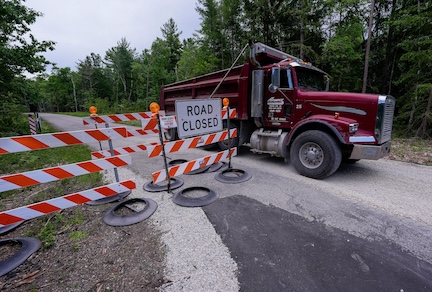
A dump truck pulls out from a construction zone on June 16, along South Norway Road at Potawatomi State Park near Sturgeon Bay. (USA TODAY Network photo)
Door County group sues DNR over Potawatomi park project
USA Today Network//June 17, 2026//


 Listen to this article
IN BRIEF
- A Door County nonprofit filed suit against the Wisconsin DNR over road widening and tree clearing at Potawatomi State Park.
- The lawsuit alleges the project violates the park’s master plan and bypassed required public notice and hearings.
- Plaintiffs seek a court order halting the project and preventing similar future work without proper approvals.
A Door County citizens group is suing the Wisconsin Department of Natural Resources over an ongoing road widening and tree clearing project at Potawatomi State Park in Sturgeon Bay that the group claims is illegal for several reasons.
The suit claims a project begun in early 2026 to significantly widen and straighten parts of South Norway Road and Shoreline Road in the park, and the resulting clearing of trees and loss of tree canopies throughout the work areas and disturbance of an environmental area near the Niagara Escarpment, is not included in the DNR’s own plan for the park, which the agency’s rules say must be followed.
The 2018 Northern Lake Michigan Coastal Regional Master Plan, adopted by the Wisconsin Natural Resources Board, can be modified, but the state requires an amendment to the plan to be filed with the board and a public hearing before changes can be adopted. The suit alleges no such amendment was filed, no notification was given of the specific work now taking place and a hearing was never held.
“The DNR is continuing to violate the Master Plan every day through road-widening activities that have not been authorized by the Master Plan,” the suit says.
The suit was filed June 12 in Door County Circuit Court by POTPARKPATCH, Inc., aka PATCH (Potawatomi Advocates for Trees, Conservation and Heritage), a Sturgeon Bay-based nonprofit whose stated purpose is “to advocate for preservation and protection of trees and the natural environment in Potawatomi State Park,” according to the complaint. David J. Allen of Sturgeon Bay is listed as the agent of record for the group and one of three directors.
Brian H. Potts, a Madison-based attorney with national law firm Husch Blackwell LLP, is representing PATCH.
Along with the DNR, Secretary Karen Hyun was named as a defendant. In an email reply to the media, the DNR’s Public Affairs Section said it is unable to comment on ongoing litigation.
The Friends of Potawatomi State Park, the volunteer organization that promotes the park and supports it through fundraising and volunteer service, is not involved on either side of the lawsuit.
The Friends’ board of directors issued a statement June 16 that said while it works with the DNR and park staff, all responsibility for the planning, design or approval of construction projects in the park is with the DNR. It also said the board unanimously passed a resolution in May asking involvement and communication from the DNR on future projects.
“We are committed as an organization to try to bring Friends volunteers, the DNR, and the public together for a discussion about future needs in the park,” the statement said.
The statement also said the Friends will not have further comment as an organization while the suit is ongoing and asked people concerned about the project to contact the DNR.
PATCH seeks declaratory judgments from the court that the work is in violation of state codes because it’s not part of the master plan and didn’t meet the rules for public notification and hearing.
It also seeks a permanent injunction to stop the work currently in progress, along with an injunction against similar future projects elsewhere in the park without the DNR following its rules for such work. The suit says a second phase of the project calls for similar work on North Norway Road and other roads in the park that isn’t in the master plan.
The suit also asks for “all other and further relief as the court deems just and equitable,” as well as court costs and fees. It’s not obvious what that would entail, as the plaintiffs acknowledge in the suit that “the harm already caused to the southern portion of the park cannot be remediated in any reasonable timeframe” because of the length of time it would take to reestablish the lost trees.
South Norway and Shoreline are being widened from their previous 18- to 20-foot widths to 28 feet wide, which will accommodate 3-foot-wide bike lanes on each side. The winding South Norway Road also is being made straighter, which the suit says necessitated the clearing of a swath of trees and vegetation about 150 feet wide and destroys the character of the road.
The project also led to the removal of distinctive tree-lined medians in the road and the canopies formed by trees along about 1.75 miles of those roads of parking lots were removed, along with trees that formed a screen for parking lots in the park.
As noted in the lawsuit, the Regional Master Plan for the park calls to limit road work to “maintenance of existing roads and parking lots at current development levels” in the short-term while the long-term prescription says, “[t]he level of development, open and closed status, and miles of roads will remain consistent with the Land Management Classification.”
The suit then notes the plan carries no authorization for road widening, road realignment or removal of the tree canopies, as it says is now happening.
It says the DNR’s 2024-25 Annual Property Implementation Plan for Potawatomi State Park listed the project as “Road Resurfacing” with no mention of widening roads or removing trees.
“The project constitutes a ‘plan revision’ because it fundamentally alters the goals and objectives for the park by permanently changing the recreational character, canopy structure and road design of the park’s road corridors, all requiring NRB approval,” the suit says.
“Widening roads from 18-20 feet to 28 feet, clearing a 150-foot swath to straighten South Norway Road, and removing tree medians and canopy over 1.75 miles of corridor does not constitute ‘maintenance’ at current development levels’ or roads ‘remain(ing) consistent.'”
The DNR issued a news release Feb. 20 that said it was clearing trees on roads near the park entrance to remove obstructions for aircraft flying into and out of Door County Cherryland Airport, which borders the park on its southwest corner. The news release did not mention any other projects or construction work, the suit says.
It also claims no mention was made of road widening or tree clearing by Park Superintendent Erin Brown-Stender during the March 2026 meeting of the park’s Friends group, with the work described as electrical upgrades, water pipe replacement and road resurfacing.
The suit claims the first time the DNR publicly acknowledged the work in the park entailed road widening for the addition of bicycle lanes came in a May 22 update to the DNR’s Park Conditions webpage, “after the majority of tree clearing had already been completed for Phase 1 of the project.”
“The DNR did not seek or obtain NRB approval before the project commenced,” it said. “The DNR did not provide public notice of road widening, tree clearing, bike lane construction, or escarpment buffer encroachment to the public before the project commenced. The DNR did not hold a public hearing.”
It also says there’s no mention in the master plan of the second phase of the project that they allege is in the works.
Also at issue is the claim that the work on part of Shoreline Road falls within a 200-foot buffer zone mandated by the Regional Master Plan for the face of the Niagara Escarpment. The plan says the DNR will “not conduct management or development … or allow uses that would disturb soil and forest canopy cover and negatively impact the core habitat area of the Niagara Escarpment” in the buffer zone.
The suit alleges that grading, soil disturbance and tree clearing has taken place within or immediately adjacent to the buffer zone along Shoreline Road, including removal of northern white cedar and other vegetation from slopes adjacent to the cliff face.
It also notes that the master plan says the area below the cliff face is a habitat for rare plants, such as climbing fumitory, and rare snails, including threatened and endangered species that could be impacted by work within the buffer zone, such as the loss of tree cover and compacting of air vents on the slopes.
The DNR has 45 days from the date the suit was filed – until July 27 – to respond in writing to the court and the plaintiff’s attorney. If a proper response is not sent, the court could grant judgments against the defendants and the defendants could lose the right to object.
Related Articles
Related Content






Polls
 Loading ...
Legal News
- Door County group sues DNR over Potawatomi park project
- Judge denies Dugan bid to overturn conviction
- Trump allies plead not guilty in Wisconsin elector case
- Minocqua Brewing sues Wisconsin over beer seizure
- Secretary of State candidate faces ballot signature questions
- DOJ appeals ruling on Wisconsin voter data access
- Manitowoc accountant gets probation in $42K theft case
- Wisconsin dairy farmers sue over federal checkoff program
- Wausau man admits role in $14.25M investment fraud
- Milwaukee reckless driving convictions surge to 84%
- Wisconsin Supreme Court takes redistricting appeal
- Prisons ban media from recording calls with inmates
Case Digests
- Residential Leases-Wisconsin Consumer Act
- Landlord-Tenant Law
- 6th Amendment-Postconviction Motion
- Administrative Law-Municipal Authority
- Landlord-Tenant Regulations
- Negligence-Doctrine of Res Ipsa Loquitur
- Bankruptcy Plans-Administrative Priority Claims
- Fee Allocations
- First Amendment-Trade Libel
- Sentencing Guidelines-Mitigation Arguments
- Fourteenth Amendment
- Sentence Enhancement-Statutory Interpretation