Free Newsletter

Wisconsin court upholds Menominee tribal immunity
MaryBeth Matzek, Freelance Editor//June 25, 2026//
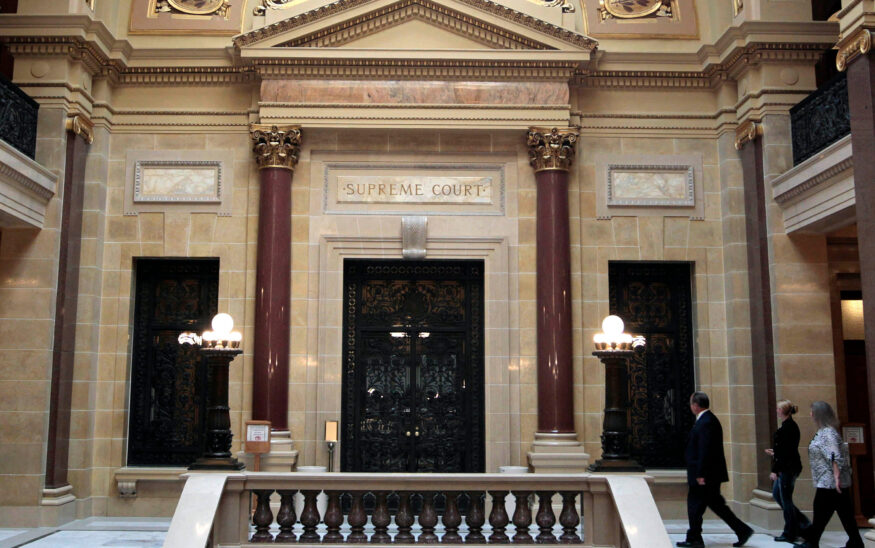
(USA Today Network)
Wisconsin court upholds Menominee tribal immunity
MaryBeth Matzek, Freelance Editor//June 25, 2026//


 Listen to this article
IN BRIEF
- Wisconsin Supreme Court ruled 4-3 that the Menominee Tribe and tribal member Guy Keshena are protected by sovereign immunity.
- The lawsuit was filed by the Legend Lake Property Owners Association over tribal reacquisition of former reservation lands.
- Three justices dissented, arguing tribal immunity should not extend to property within another sovereign’s territory without explicit congressional authorization.
The Menominee Tribe and one of its members cannot be sued by a group of Menominee County landowners, according to the Wisconsin Supreme Court.
The court issued a 4-3 decision this week in a case filed by a group of private landowners, the Legend Lake Property Owners, against the Menominee Tribe and one of its members, Guy Keshena, to restrict the use of trust land. The court said the tribe and Keshena were protected by tribe’s sovereign immunity.
When the tribe was stripped of federal recognition in the 1950s, it sold thousands of acres to reduce its debts, including property that would later be used for the Legend Lake development. When federal recognition for the Menominee was restored in 1973, Congress’ Restoration Act allowed the tribe to recover its lost land.
The Menominee chairman later appointed Keshena to acquire Legend Lake property, which could then be placed in trust.
The Supreme Court said the property owners association made changes to its bylaws in 2001 and 2009 that were “plainly aimed at preventing the tribe from reacquiring its former reservation lands.”
After Keshena acquired 30 properties on behalf of the tribe and put them into trust, the association sued him and the tribe, arguing Congress’ Restoration Act abrogated the tribe’s sovereign immunity and that the Menominee Nation waived its immunity in several ways, including when Keshena accepted deeds to the properties after the association updated its bylaws with restrictive covenants.
Writing for the majority, Justice Susan Crawford rejected that argument.
“Tribal sovereign immunity is the rule, not the exception. A litigant can overcome tribal sovereign immunity if Congress abrogates it or if a tribe clearly waives it. Neither occurred here,” she said. “Nor does the Association persuade us that… exceptions defeat a tribe’s sovereign immunity from suit.”
The majority outlined the U.S. Supreme Court said immunity is the baseline for tribes unless it is explicitly waived or abrogated. In addition, the state court found no waiver by the tribe through the restrictive covenants or Keshena’s actions.
The court’s three conservatives disagreed with the majority’s opinion, saying tribes do not have immunity over property in another sovereign’s territory unless explicitly stated by Congress.
In her dissent, Justice Rebecca Grassl Bradley, who was joined by Justice Annette Kingsland Ziegler, said the majority “invents a new immunity for tribes out of whole cloth.”
Justice Brian Hagedorn also wrote a dissent, which Bradley and Ziegler joined. He said the owner of the acquired lots — the United State government — was not a part of the case and therefore the case should not be resolved without their presence.
He pointed out that after purchasing the properties, Keshena asked the U.S. government to hold the properties in trust for the tribe. Hagedorn said there were two cases going on — one federal and one state — and without the U.S. being involved in the state case, it was not right to move forward with a solution.
Related Articles
Related Content





Polls
 Loading ...
Legal News
- Judge halts tree clearing at Potawatomi State Park
- Former funeral home owner indicted in Medicaid fraud
- Enbridge settles Wisconsin pipeline spill for $275K
- Supreme Court backs end of protections for Haitians, Syrians
- Wisconsin court upholds Menominee tribal immunity
- Milwaukee prenatal care owner to plead in Medicaid fraud
- Oracle sues PSC over Wisconsin data center rules
- Worker files NLRB charges over union dues dispute
- Canadian gets prison in $1.2M mail fraud scheme
- Eau Claire firm to pay $325K in state pollution settlements
- Illinois man sentenced in Marshfield ATM theft scheme
- Wisconsin officials push to destroy 2020 absentee ballots
Case Digests
- Equal Protection Clause of the Fourteenth Amendment
- Sufficiency of Evidence-Plain Error
- 6th Amendment-Failure to Prosecute
- Relief from Judgment-Attorney Withdrawal
- Statute of Limitations-Bail Jumping
- Marital Property Division-Competency
- Standing-Marsy’s Law
- Good Faith Covenant-Banking Fees
- Voluntary Consent-Totality-of-the-Circumstances Test
- Class Action Fairness Act-Subject Matter Jurisdiction
- Policy Exclusions-Commercial Crime Bond
- Negligent Misrepresentation-Tortious Interference