Free Newsletter

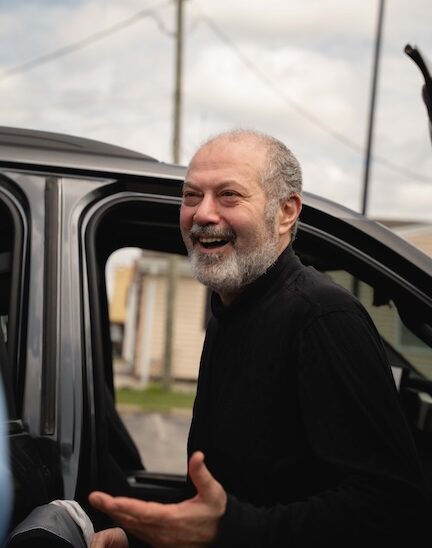
Salah Sarsour, a Palestinian activist, lawful permanent resident and Milwaukee Mosque leader, had his third immigration hearing in three weeks. (USA Today Network file photo)
Imam deportation hearing delayed until September
USA Today Network//August 5, 2026//


IN BRIEF
- A Milwaukee mosque leader’s deportation hearing ended without testimony from Salah Sarsour, with cross-examination scheduled for Sept. 14.
- Sarsour’s former Israeli attorney testified he accepted a plea deal despite believing his client was innocent and described barriers to meeting with him while detained.
- The immigration judge will decide whether Sarsour is deportable after reviewing more than 14 hours of testimony and over 1,000 pages of evidence.
The third immigration court hearing in three weeks for a Milwaukee mosque leader ended Aug. 4, without any testimony from Salah Sarsour himself.
The latest trial-like hearing in Sarsour’s ongoing deportation case saw testimony from the attorney who represented him in Israeli military court in the 1990s. That attorney, Jawad Boulos, testified about not being allowed to meet with Sarsour for a period of time while he was detained, and why he agreed to a plea deal despite believing his client was innocent.
The cross-examination of Boulos by Department of Homeland Security attorneys will take place on Sept. 14.
The immigration judge, Jayme Salinardi, said he would issue a written decision about whether Sarsour is deportable following the September hearing after reviewing the evidence, including more than 14 hours of witness testimony and over 1,000 pages of documents. Regardless of the decision, the case is expected to be appealed by either Sarsour’s attorneys or DHS.
Sarsour’s attorneys asked for the option to have Sarsour testify in September after Boulos’ cross-examination, but Salinardi said Sarsour either had to testify now or never. Sarsour’s attorneys decided not to put him on the witness stand.
“The government has repeatedly scoured Mr. Sarsour’s statements for even the most minor inconsistencies,” Patrick Taurel, one of Sarsour’s attorneys, said in court. “I don’t think I’ve seen the government throw the book at somebody quite like has happened here. Any reasonable attorney would not want his client to testify under these circumstances, unless it was absolutely necessary.”
DHS is bringing no witnesses in the case. All witnesses have appeared on behalf of Sarsour’s legal team.
Sarsour’s attorneys have argued that the government has long been aware of the circumstances of his convictions, and Israeli military authorities used torture and coercive interrogation tactics to extract false confessions from Sarsour.
Sarsour is a lawful permanent resident of the U.S. and has lived in the country legally for more than 32 years. His wife and children are U.S. citizens.
He was arrested by U.S. Immigration and Customs Enforcement agents in March in Milwaukee and accused by DHS of funding terror organizations and lying on immigration forms.
Secretary of State Marco Rubio last year issued a memo saying Sarsour was deportable on foreign policy grounds, but Sarsour’s supporters have said his arrest was a politically motivated attempt to silence his pro-Palestinian speech.
The deportation order against Sarsour focuses on a handful of separate immigration-related issues.
Throughout the immigration court hearings, the key questions have been: whether Sarsour’s two convictions as a young person by Israeli authorities were valid, whether he should have marked he had committed a crime on two U.S. citizenship applications in the 1990s, and whether he knowingly tried to register to vote in 2004.
Sarsour was arrested twice by Israeli military authorities: once as a 15-year-old in 1988 in the West Bank, and later as a 22-year-old in 1994, after he’d already moved to the U.S. and returned to the region to visit his family.
The testimony from Boulos, Sarsour’s attorney in Israel, focused on the 1994 arrest and plea deal in early 1995.
It remains unclear what exact charge Sarsour was convicted of. No Israeli conviction records have been made available, Sarsour’s attorneys have said.
One court document from that time alleged that Sarsour provided shelter to a wanted person with Hamas ties and he attempted to purchase a weapon.
That “wanted” person was Jack Nazzal, Sarsour’s brother-in-law. Nazzal himself was never charged with anything in 1994 or afterward, according to a history of his criminal record shown in court.
Nazzal was convicted previously, in 1992, of being a member of an unlawful group, but it was the lowest-level offense of that type, Boulos said. The group was not one of Israel’s “designated” unlawful groups such as Hamas – but instead, an informal group of a few people.
Boulos gave a modern-day example: If a few people are in a WhatsApp chat and one of them commits vandalism, Israeli authorities may charge everyone in the group with the offense of being in an unlawful group.
In February 1995, Boulos reached a plea deal in which that charge of providing shelter to a wanted person was dropped.
As part of the plea deal, Sarsour agreed to 130 days imprisonment, which amounted to time served. Sarsour spent 90 of those days in solitary confinement, where he has said he was repeatedly beaten until he fell unconscious. After some time, he signed a confession document in Hebrew, a language he didn’t understand, desperate to be released, according to court filings.
Boulos said that confession document was prepared by an Israeli military interrogator who spoke Hebrew and did not speak fluent Arabic. Boulos said he interacted with that interrogator many times in his 46-year career and knew interrogators like him to make crucial translation errors.
Boulos testified that Sarsour got a “fantastic” deal in comparison to most of the other Palestinian detainees accused of Hamas ties that he’s represented, and Israeli prosecutors would not have accepted a deal with such a short sentence if they actually believed Sarsour was guilty.
“I believe the authorities came to doubt that Mr. Sarsour was guilty of what was written in his confession,” Boulos wrote in a declaration.
He also said that Sarsour would have remained in custody in poor conditions for another year or two if he had continued fighting the case, giving him an incentive to take the deal.
The only two people listed as witnesses on the charging document were the two Israeli military officers who interrogated Sarsour. That fact “shows that they have nothing against Salah from other sources,” Boulos testified.
If the interrogators had gotten any valuable information from him, there would have been some indication of additional investigation in the charging document, Boulos said.
“From this file, Salah Sarsour has nothing to do with Hamas,” Boulos said.
Also shown in the immigration court hearing was an Israeli document that barred Boulos, as Sarsour’s attorney, from meeting with him for a span of four days. Boulos said he was actually not allowed by the Israeli officials to meet with Sarsour for over a month.
“It is telling that Mr. Sarsour’s ‘confessions’ occurred when I was prohibited from meeting with him,” Boulos said in the declaration submitted to immigration court.
Boulos said he remembers Sarsour’s case, more than 30 years later, because it was one of the few cases in which a detainee was transferred to a hospital as a result of harsh treatment by Israeli investigators.
He also said that when he appeared in court on Sarsour’s behalf, Sarsour was kept out of the courtroom in a separate area and then brought into the courtroom only after his attorney had been told to leave, leaving Sarsour in the dark about his own legal proceedings.
Sarsour, in his own statements, has said he did not know why he was being held and did not understand what he apparently confessed to have done.
Meanwhile, Sarsour’s attorneys have previously established that the circumstances of Sarsour’s arrest as a 15-year-old, apparently for throwing stones and throwing a Molotov cocktail at the home of an Israeli collaborator, were not completely clear.
A handwritten document from an interview with the U.S. consulate in 1993, previously shown in immigration court, stated that he “confessed that he was present, but stated that he didn’t know what was going to happen and was not involved.” He spent two years in Israeli military detention.
Immigration court is an administrative court housed under the U.S. Department of Justice. Immigration judges, who make decisions on asylum and deportation cases, are appointed by the attorney general. There is no jury.
The Trump administration has fired more than 100 immigration judges. Critics say it is ousting judges it views as lenient and is trying to reshape the immigration court system.
Salinardi, who is an assistant chief immigration judge, rules against asylum claims at a high rate. He denies asylum claims 90% of the time, compared to a national average of 59%, according to Transactional Records Access Clearinghouse data.
Before he was appointed by Democratic Attorney General Loretta Lynch in 2016, Salinardi was an attorney for ICE.
Related Articles
Related Content





Polls
 Loading ...
Legal News
- Group sues to block Evers on online betting
- Lawyer seeks subpoenas in Green Bay ballot probe
- Supreme Court brings Justice on Wheels to Chippewa Falls
- Imam deportation hearing delayed until September
- When Workplace AI Becomes Harassment Evidence in Wisconsin
- Groups sue DNR over Enbridge Line 5 water permits
- Van Orden presses Evers on federal aid recipient data
Case Digests
- Termination of Parental Rights-Reasonable Efforts
- Family Law- Appellate Procedure
- Involuntary Administration of Medication-Mootness Exception
- Voluntary Consent to blood Draw- -Fourth Amendment
- Expert Testimony-Medical Malpractice
- Habeas Corpus-Bond Eligibility-Immigration Detention
- Fair Credit Reporting Act
- Copyright Infringement-Tortious Interference
- Tribal Land Trespass-Unjust Enrichment
- Fourth Amendment-Automobile Exception
- Age Discrimination in Employment Act-But For Causation
- Class-of One Equal Protection Claim-Breach of Contract
Legal Tech
- AI is reshaping family law practice, but attorneys worry about DIY research
- Massachusetts court rejects work product protection for AI documents by girlfriend
- Exterro launches on-premises AI platform for digital forensics