Free Newsletter

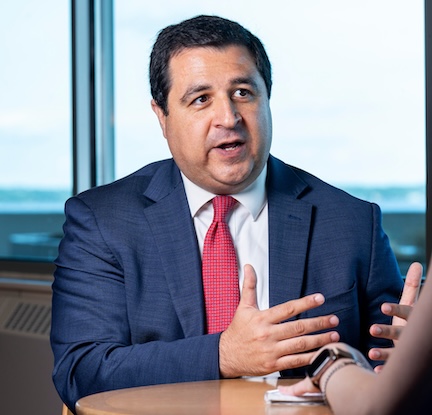
Wisconsin Attorney General Josh Kaul responds to interview questions during the 2026 Wisconsin Democratic Convention at the Monona Terrace Community and Convention Center in Madison on June 13. (USA Today Network)
State Supreme Court backs Kaul on settlement funds
USA Today Network//July 10, 2026//


IN BRIEF
- Wisconsin Supreme Court ruled 5-2 in favor of Attorney General Josh Kaul.
- Decision allows Kaul to direct multi-state lawsuit settlement funds to state programs.
- Ruling overturns a previous appeals court decision requiring funds to go to the state’s general fund.
MADISON — Wisconsin’s Supreme Court sided with Attorney General Josh Kaul in a dispute with Republican lawmakers, ruling that he can credit money from multi-state lawsuit wins directly to state programs.
The 5-2 decision overturns a previous ruling that required the money to go directly into the state’s general fund and be directed for use by the Legislature.
The court’s liberal majority consisting of Chief Justice Jill Karofsky, Justices Janet Protasiewicz, Rebecca Dallet and Susan Crawford and conservative swing-vote Justice Brian Hagedorn ruled that Kaul was acting within his abilities when he directed money be given to programs related to the settlement funding.
Conservative Justices Rebecca Bradley and Annette Ziegler, who are both leaving the court, dissented.
The lawsuit stems from one of the bills passed during the lame-duck sessions in December 2018, aimed at curbing the abilities of Democratic Gov. Tony Evers and Kaul before they took office. The law required that funding from multi-state lawsuits be placed in the state’s general fund.
In 2021, the Legislature sued Kaul, claiming that he was illegally placing settlement money into an account he controlled.
According to online court records, the case was filed in Polk County Circuit Court, where the judge sided with Kaul in 2022. The Legislature appealed, and the Polk County decision was reversed in 2024. Kaul petitioned the Supreme Court to review the case earlier this year.
During oral arguments in January, lawyers for the Legislature said the money from multi-state settlements should be placed into the state’s general fund, and that the Department of Justice shouldn’t be able to move it without approval from the Joint Finance Committee, according to a report from Wisconsin Public Radio.
An attorney for the DOJ argued that the agency should be able to deposit settlement funds into the state treasury, and credit the money to various programs.
The case is of particular interest due to the number of multi-state lawsuits Kaul has joined against the Trump administration, challenging everything from rollbacks in regulations to the funding that was cut for infrastructure projects.
Perhaps the biggest multi-state settlement Wisconsin has received was from opioid manufacturers, funding that had to go through several rounds of approvals by the Legislature before it could be sent to communities to help those struggling with addiction.
In addition to the ruling on what to do with settlement funds, the Court also heard arguments on whether funds from multi-state lawsuits are considered “proceeds from services,” which was dismissed by the majority. Hagedorn dissented with that portion of the ruling.
“The court’s inability to come together leaves the parties with no clarity about how to conform their actions to the law,” he said in his dissent. “It is most unfortunate that the court – even while we agree – cannot produce an opinion effectuating our agreement. The parties deserve better, and so does Wisconsin.”
In the dissent, Bradley and Ziegler argued that “this is not the first time justice has taken a back seat to political interests,” and that the money won by these cases should not be utilized to fund DOJ programs.
“The members of the majority extend the Democrats’ almost unbroken winning streak in litigation against the Republican legislature since the progressives took control,” Bradley wrote. “In Wisconsin and elsewhere, ‘darkness descends on the Rule of Law.'”
The court’s liberal majority will expand to 5-2 next month with the swearing in of Chris Taylor, who defeated conservative Maria Lazar in a race to succeed Bradley on the court.
Related Articles
Related Content




Polls
 Loading ...
Legal News
- State Supreme Court backs Kaul on settlement funds
- Green Bay clerk placed on leave amid ballot probe
- DOJ warns Wisconsin over noncitizen voter rolls
- Muslim woman sues over Waukesha jail hijab policy
- Dugan appeal could stretch into 2027
- Elijah Vue’s mother seeks new attorney before 2027 trial
- Dugan avoids prison in ICE obstruction case
- Man gets probation for threatening judge on Facebook
- 47 charged in Ridglan Farms beagle raid case
- Wisconsin high court rejects voter records request
- Wisconsin Supreme Court pauses ICE detainer lawsuit
- Former EPA staff sue over First Amendment firings
Case Digests
- Mootness Doctrine-Harmless Error
- Chapter 51 Commitments Commitment-Harmless Error
- Dangerousness Standard-Criminal Competency
- Americans with Disabilities Act- Termination of parental rights
- Abuse of Discretion-Waiver to Adult Court
- Termination of Parental Rights – Ineffective Assistance of Counsel
- Right of Survivorship-Appellate Procedure
- Judicial Vindictiveness-Sentencing
- Sentencing Discretion-No-Contact Order
- Exclusionary Rule and Blood Draw Procedures-Ineffective Assistance of Counsel
- Plea Agreement-Criminal Procedure
- Voting Rights Act-Vote Dillution