Free Newsletter

Supreme Court approval dips amid tariff ruling divide
MaryBeth Matzek, Freelance Editor//April 23, 2026//
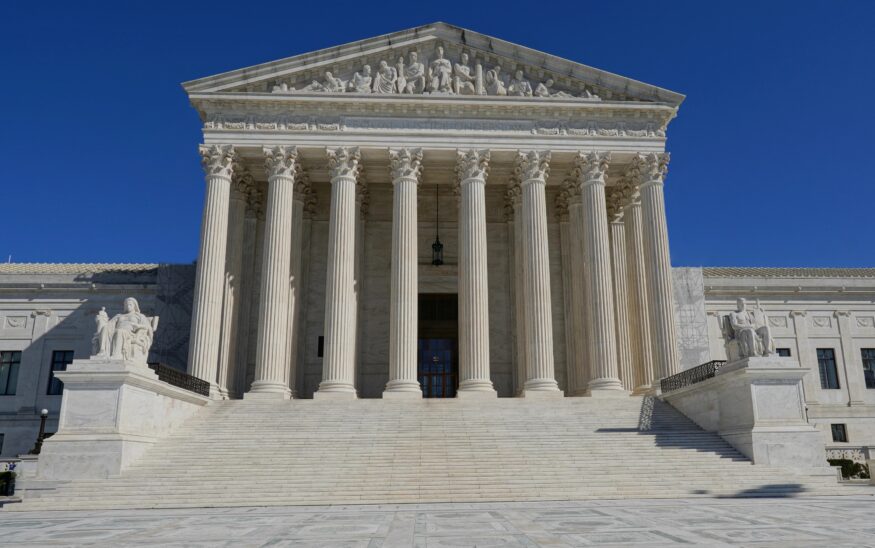
(Deposit Photos)
Supreme Court approval dips amid tariff ruling divide
MaryBeth Matzek, Freelance Editor//April 23, 2026//


 Listen to this article
IN BRIEF
- 66% support Supreme Court ruling limiting Trump tariff authority.
- Court approval rating drops to 42% in April survey.
- Majority believe court may avoid rulings Trump could ignore.
A new Marquette Law School Poll national survey finds partisan divides on most Supreme Court cases, with the overall approval rate of the court slipping.
The survey, which was released today, found that 66% of respondents favored the U.S. Supreme Court’s Feb. 20 ruling that President Donald Trump did not have authority to impose tariffs under the International Emergency Powers Act (IEEPA) while 33% oppose the decision. Partisans view the decision differently, with 61% of Republicans opposing the ruling while 71% of independents favor the ruling, as do 92% of Democrats.
Opinion of the ruling was strongly influenced by opinion of Trump’s handling of tariffs. Of those who approve of his handling of tariffs, 76% oppose the decision, while among those who disapprove of his job on tariffs, only 11% oppose the court’s decision.
The ruling against a major Trump policy did little to change the public impression that the court is going out of its way to avoid making a ruling that Trump might refuse to obey. In April, 57% say the court is avoiding such a ruling, unchanged from January. A majority of Republicans (67%) say the court is not avoiding ruling against Trump, while majorities of independents (66%) and Democrats (79%) say the court is avoiding this.
The overall approval rate of the court continues to decline. In April, the approval rate was 42% compared to 44% in January. Among Republicans, the court approval rating fell to 70% from its January level of 78%. Among independents, court approval improved slightly from 26% in January to 29% in April. Democrats also slightly more approving of the court from 17% in January to 19% in April.
Since Trump returned to office, the court’s approval rating has steadily declined. In March 2025, it was 54%. The court’s lowest-ever approval in Marquette Law School polling was 38% in July 2022, immediately after the Dobbs decision that overturned Roe vs. Wade, ending nationwide abortion rights. The court’s highest approval rating came in September 2020 when it reached 66%.
With rare exceptions, the public does not follow news about the Supreme Court as much as news about other subjects. In April, 35% had heard or read a lot about the February tariff ruling, while 52% had heard a little and 13% had heard nothing at all.
Also in April, 26% said they had read or heard a lot about the court in just the last month, while 61% heard a little and 13% heard nothing at all.
Attention to news about the court rises around the end of the court’s term in June when many major decisions are handed down. In combined Marquette Law School Poll national surveys conducted in July 2024 and 2025, shortly after the end of the court’s term, 33% said they had heard a lot about the court, while in polls conducted in other months 23% had heard a lot.
The national survey, which was conducted April 8-16, interviewed 982 adults nationwide, with a margin of error of +/- 3.4 percentage points.
Related Articles
Related Content




Polls
 Loading ...
Legal News
- WLJ is proud to endorse Best Places to Work in Law Firms
- Residents sue over Driftless region transmission line
- Wisconsin Supreme Court appeal looms in map cases
- Brewers’ fans lose $13,000 raffle dispute in court
- State sues Trump over nursing student loan cuts
- Milwaukee to pay $575K to settle swatting lawsuit
- Oshkosh theater president accused of stealing $15,000
- Wisconsin ICE detainee lawsuit sent back to state court
- Judge denies venue change in Elijah Vue death case
- League of Women Voters sues over absentee ballot rules
- Man pleads not guilty to stealing ambulance while naked
- Evers unaware of ‘widespread’ FBI probe in 2020 election
Case Digests
- Attorney License Revocation-Sexual Harassment
- Extrinsic Evidence Rule-Corporate Officer Liability
- Ineffective Assistance of Counsel
- Medicaid Fair Hearing-Notice and Hearing Rights
- Termination of Parental Rights-Substantial Relationship Test
- Individuals With Disabilities Education Act-Plain Error Review
- Jurisdictional Authority-Sufficiency of Evidence
- Fourth Amendment-Evidence Suppression
- Rehabilitation Act-Hostile Workplace
- Federal Arbitration Act-Refusal to Arbitrate
- Breach of Agreement-Mootness-Tax Assessment
- Domestic Abuse-Ineffective Assistance of Counsel (Subsequent Counsel)-Intimidation