Free Newsletter

Avery’s paths to appeal narrow, expert says
USA TODAY Network//December 26, 2025//
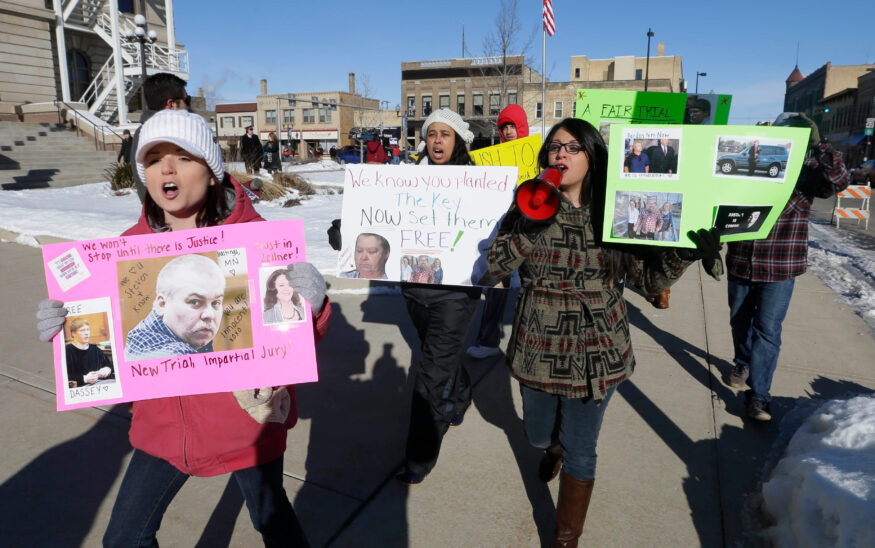
A group of about 100 demonstrators gathered peacefully outside the Manitowoc County Courthouse to protest the convictions of Steven Avery and Brendan Dassey on January 29, 2016. USA TODAY Network file photo
Avery’s paths to appeal narrow, expert says
USA TODAY Network//December 26, 2025//


IN BRIEF
- Steven Avery plans to file his first federal habeas corpus petition after state appeals were denied.
- The Wisconsin Supreme Court declined to review Avery’s latest post-conviction motion in May.
- Legal experts say federal appeals face strict limits under federal habeas law.
A decade since the Netflix series “Making a Murderer” made Steven Avery a household name in the world of true crime, the now-63-year-old Avery and his attorney continue to try to prove he’s innocent.
Avery was convicted in 2007 of murdering 25-year-old Teresa Halbach on Halloween 2005. At the time of Halbach’s death, Avery had been free from prison for just over two years after serving 18 years for a 1985 sexual assault he didn’t commit.
Released in December 2015, the 10-part docuseries was the work of two Columbia University students who closely followed and documented the 2006–07 court proceedings for Avery and his teenage nephew involved in the case, Brendan Dassey.
With the show’s release, details about Halbach’s murder went from small-town lore to an internationally discussed true-crime story. “Making a Murderer” put Avery’s and Dassey’s cases – and their appeal efforts – on a global stage.
While Dassey has largely exhausted his judicial paths to appeal, Avery continues to fight to get his case back in front of a judge.
The most recent decision on Avery’s appeal efforts came in May, when the Wisconsin Supreme Court declined to review the state Court of Appeals’ denial of Avery’s third motion for post-conviction relief.
Avery’s attorney, Kathleen Zellner, said at the time that the next step would be to file a petition in federal court.
Zellner said Avery plans to file a habeus corpus petition in federal court – the first time his case has risen to the federal level. But she didn’t provide a time frame for when it’ll be filed.
“We are evaluating all of our options including new DNA testing utilizing the substantial improvements made in DNA testing equipment since 2005,” Zellner said in a Nov. 12 email. “Mr. Avery has multiple options and no time bar to presenting new exculpatory evidence.”
But appealing a conviction is difficult – especially after repeated denials, legal expert Adam Stevenson said.
“Making a Murderer” highlighted the unusual set of circumstances surrounding Avery’s murder conviction.
In 1985, at age 23, Avery was wrongfully convicted of first-degree sexual assault and attempted first-degree murder at trial. The victim, a 36-year-old woman who was assaulted while jogging, identified Avery from a police lineup that didn’t include the actual perpetrator. Avery was sentenced to 32 years in prison.
In 2003, after serving 18 years of his sentence, Avery was exonerated when DNA evidence determined the assailant’s real identity – Gregory Allen, who was by that time in prison serving a 60-year sentence for a separate sexual assault in Green Bay that happened around a decade after the 1985 case.
On Oct. 31, 2005, Halbach, a freelance photographer from St. John, in neighboring Calumet County, went to the Avery family’s 40-acre auto salvage yard outside Two Rivers on an assignment for an auto trade magazine. She was never seen again.
Avery was arrested and charged with Halbach’s murder after a large amount of evidence was found on family property. Halbach’s vehicle was in the salvage yard, partially covered with branches and with a disconnected battery. Remnants of her camera and cellphone were in a burn barrel on the property, and human bone fragments, which experts said were from Halbach, were located in and around a burn pit. Among other evidence, Avery’s and Halbach’s blood was found in the vehicle and its key was found in Avery’s bedroom.
At the time of his arrest, Avery had been a topic in the news and in legal circles. He had a pending lawsuit against Manitowoc County and former county officials for his wrongful conviction, in which he was requesting a payout of $36 million – he eventually settled for $400,000.
A task force in Avery’s name led to the introduction of legislation aimed to avoid wrongful convictions through reform of things like eyewitness evidence and DNA preservation, just about a month before Avery’s arrest.
Since 2009, Avery has filed multiple motions for post-conviction relief.
It’s expected for a defendant’s appeal process to take multiple years, Stevenson said. However, each motion denial narrows what more can be done.
“As you move, whether it’s in time or whether it’s in number and types of filings beyond sentencing … the pathway is more and more more difficult, more and more limited for an individual to basically do anything to their case – overturning a conviction, adjusting a sentence, things like that,” Stevenson said.
A motion for post-conviction relief is a request to a judge to take another look at a conviction or sentence due to alleged errors that weren’t addressed at trial court proceedings and is typically the first step for Wisconsin defendants seeking to appeal a conviction.
Avery’s first post-conviction motion, filed in 2009, was denied in Manitowoc County Circuit Court in 2010. In that motion, he argued that law enforcement violated his constitutional rights and the trial judge wrongfully excused a juror at trial and replaced them with an alternate. Avery then attempted to appeal that denial through the Wisconsin Court of Appeals, but that court upheld the circuit court’s decision in 2011. The Wisconsin Supreme Court then declined to review the case.
Avery tried again in 2013, when he filed a motion “pro se,” which means without attorney representation. That motion was denied at the circuit court level in 2015, and Avery tried to appeal that decision to the appellate court in December 2015.
However, the release of “Making a Murderer” that same month caught the attention of Zellner, a Chicago attorney specializing in wrongful convictions, and she took the case. With Zellner’s involvement, Avery voluntarily dismissed his pro se appeal.
With the new legal team, Avery filed a second motion for post-conviction relief in 2017. More than 1,200 pages, it made various allegations, including that law enforcement planted evidence against Avery and false testimony was given at trial. The motion was denied, and appeals to that decision took the appeal through 2021, when the state Supreme Court declined to review the case.
Avery filed his third motion for post-conviction relief in 2022, alleging that another man killed Halbach, framed Avery by leaving the key to Halbach’s vehicle in Avery’s bedroom and then was a key witness against him at trial. The motion claimed new evidence supported these allegations. It was again denied at every level, ending with the Wisconsin Supreme Court in May.
Stevenson said there are caveats to a defendant’s ability to seek post-conviction relief through a federal court.
It can only look at alleged violations of the U.S. Constitution and federal statutes, he said. However, this narrow power over state criminal cases was further narrowed by 1996 legislation, the Antiterrorism and Effective Death Penalty Act, known as ATEDPA.
One thing ATEDPA did was set a strict one-year time limit on the filing of a federal habeus corpus petition. This one-year clock starts after the judgment of conviction is finalized, shortly after a case’s conclusion. However, it can also start after “newly discovered” facts or evidence related to a U.S. constitutional claim, Stevenson said.
However, this fact or evidence must be both not previously known and could not have been known through reasonable investigation, he said.
For example, Stevenson said, “a person can’t sit in prison for five years not attempting to investigate and then start at that fifth year and go, ‘Oh my goodness. I found something.’ If they could have found it earlier, that isn’t newly discovered.”
“This one-year clock is a very important and often very difficult thing to overcome for folks, especially later on in cases,” he said.
Stevenson said that, if Avery files a federal habeus corpus petition and that gets denied, he could potentially file another in the future – but it gets less and less likely to be successful.
That’s because ATEDPA raised the bar for “second or successive” habeus corpus petition, requiring that the facts of the new claim are enough to establish that “but for constitutional error, no reasonable fact finder” – meaning the jury in Avery’s case – would have found the defendant guilty.
“Essentially, the new piece of evidence wouldn’t have simply maybe given rise to a different argument at trial, but it itself would be essentially the piece that would change what the fact finder would do, from convict to acquit,” Stevenson said.
A successful second or successive habeus corpus petition is really possible only if a defendant finds “the proverbial silver bullet,” Stevenson said.
This is the territory Dassey’s in after his federal habeus petition was denied – but only after he came very close to succeeding.
Dassey was arrested in 2006 after the then-16-year-old told law enforcement that he sexually assaulted Halbach at Avery’s command and assisted his uncle in killing Halbach and burning her body. His police interview drew criticism by his attorneys and legal experts for interrogation tactics that they said took advantage of his age and IQ that bordered on intellectual disability.
In 2016, U.S. Magistrate Judge William Duffin overturned Dassey’s conviction after reviewing his federal habeus corpus petition. The ruling granted Dassey’s petition for either release or a new trial. In his 91-page decision, Duffin said Dassey’s constitutional rights were violated, and the judge criticized investigators, state courts and Dassey’s pre-trial attorney for how they handled the case.
Prosecutors appealed Duffin’s ruling, but a three-judge panel of the U.S. Court of Appeals for the 7th Circuit – which oversees lower courts in Wisconsin, Illinois and Indiana – affirmed the decision, 2-1, in June 2017.
However, prosecutors then sought further review by the full 7th Circuit Court, which upheld Dassey’s conviction, 4-3.
The majority opinion said they didn’t find that Dassey’s confession to police was coerced. The dissenting opinion called the decision “a travesty of justice.”
The only higher court to hear appeals of federal court rulings is the U.S. Supreme Court. In June 2018, the Supreme Court announced it would not hear Dassey’s case.
Aside from motions and petitions, defendants seeking post-conviction relief can request clemency from the U.S. president or state governor, Stevenson said. Clemency primarily comes in two forms: a pardon, which erases a conviction and restores a person’s legal rights, or commutation, which shortens a person’s sentence.
In 2019, Dassey petitioned Gov. Tony Evers to grant him clemency, but Evers denied it. In 2022, Avery’s trial attorneys, Dean Strang and Jerome Buting, wrote a letter to Evers, requesting clemency for Dassey.
While Avery is serving a life sentence with no possibility of release from prison on extended supervision, Dassey may be eligible for release in 2048, when he’s 59 years old.
Related Articles
Related Content






Polls
 Loading ...
Legal News
- Group sues to block Evers on online betting
- Lawyer seeks subpoenas in Green Bay ballot probe
- Supreme Court brings Justice on Wheels to Chippewa Falls
- Imam deportation hearing delayed until September
- When Workplace AI Becomes Harassment Evidence in Wisconsin
- Groups sue DNR over Enbridge Line 5 water permits
- Van Orden presses Evers on federal aid recipient data
Case Digests
- Termination of Parental Rights-Reasonable Efforts
- Family Law- Appellate Procedure
- Involuntary Administration of Medication-Mootness Exception
- Voluntary Consent to blood Draw- -Fourth Amendment
- Expert Testimony-Medical Malpractice
- Habeas Corpus-Bond Eligibility-Immigration Detention
- Fair Credit Reporting Act
- Copyright Infringement-Tortious Interference
- Tribal Land Trespass-Unjust Enrichment
- Fourth Amendment-Automobile Exception
- Age Discrimination in Employment Act-But For Causation
- Class-of One Equal Protection Claim-Breach of Contract
Legal Tech
- AI is reshaping family law practice, but attorneys worry about DIY research
- Massachusetts court rejects work product protection for AI documents by girlfriend
- Exterro launches on-premises AI platform for digital forensics

.png)