Free Newsletter

Court: Ballots cannot be rejected for lack of election official initial
MaryBeth Matzek, Freelance Editor//March 6, 2025//
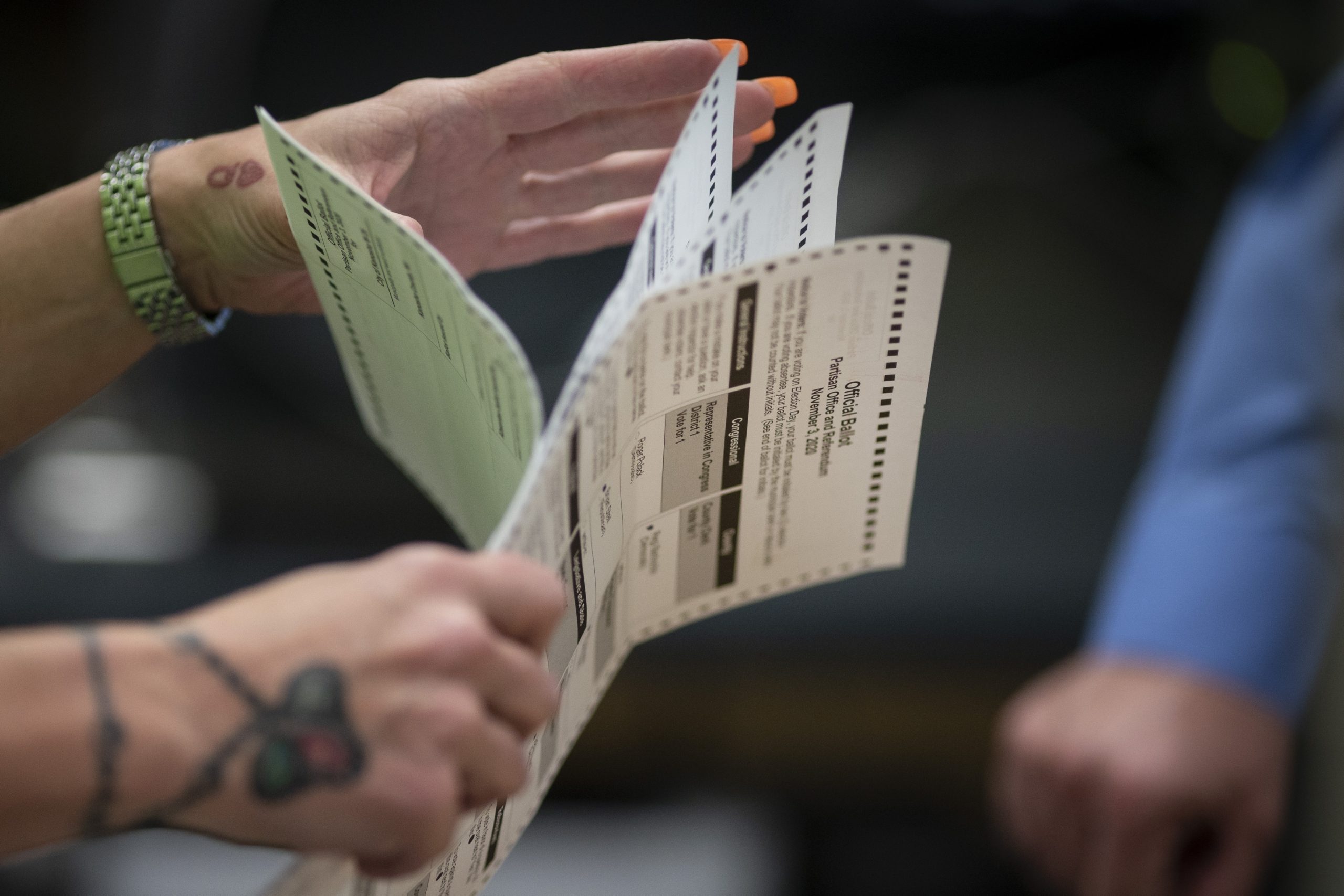
AP file photo
Court: Ballots cannot be rejected for lack of election official initial
MaryBeth Matzek, Freelance Editor//March 6, 2025//


 Listen to this article
IN BRIEF
- The Court of Appeals IV ruled election ballots cannot be rejected if they are not initialed by the appropriate election official.
- Genia Stevens beat Tammy Gonfiantini by three votes for a seat on the Rock County Board of Supervisors. During a recount, Gonfiantini challenged three ballots — all for Stevens — that had not been initialed by the appropriate election official.
- The Court of Appeals ruled state statutes do not allow ballots to be rejected for lack of a signature of an election official.
The Court of Appeals IV ruled Thursday that ballots cannot be rejected if they are not initialed by the appropriate election official.
The decision comes from a case in Rock County where the board of canvassers declared Genia Stevens the winner in an election for a seat on the county board of supervisors. In the April 2024 election, Tammy Gonfiantini faced Stevens in an election to fill a county board seat. The Board of Canvassers announced Stevens received 346 votes and Gonfiantini received 343 votes. Gonfiantini petitioned for a recount.
During the recount, she challenged several ballots, including three ballots — all votes for Stevens — on the grounds they had not been initialed by the appropriate election official. The board rejected her challenge to the unendorsed ballots based on guidance issued by the state elections commission that ballots could not be rejected for that reason. After addressing Gonfiantini’s challenges, Stevens was declared the winner.
Gonfiantini then filed a “complaint and notice of appeal or recount” in Rock County Circuit Court naming the Rock County Board of Canvassers and Rock County Clerk Lisa Tollefson as notice parties. Stevens retained her own counsel and appeared in the action as an interested party. In her complaint, Gonfiantini alleged the three unendorsed ballots should not have been counted, and that the board’s decision to count them was a mistake.
The defendants and Stevens filed a motion to dismiss, arguing the challenge to the unendorsed ballots was consistent with Wisconsin Statute 7.51, which governs the canvassing and tallying of votes on election night, and Wisconsin Statute 9.01, which governs the recount procedure. The circuit court granted the motion to dismiss, which Gonfiantini appealed.
After Gonfiantini submitted her appellant’s brief, Stevens filed a motion asking the court to impose sanctions for a “frivolous appeal.”
When looking at election-related state statutes 6.80, 7.37, 6.88, 7.51 and 9.01, the Court of Appeals wrote they “unambiguously establish that the lack of inspector or clerk initials on a ballot is not by itself a reason for rejecting the ballot … Unendorsed ballots must be counted in the election unless there is a reason beyond the lack of an endorsement to reject them, such as when the total number of ballots exceeds the total number of electors recorded in the poll books.”
According to court records, Gonfiantini did not “meaningfully address any of (the) statutory provisions” in her appellate briefing. Instead, she focused on statute 6.84, which looks at the “legislative policy” regarding absentee voting.
The Court of Appeals denied the argument because “the endorsement requirement of Wis. Statute 6.87(1) is not among the mandatory provisions” listed in Statute 6.84. “Accordingly, 6.84 actually undermines Gonfiantini’s argument that unendorsed absentee ballots should not be counted …”
The court wrote Gonfiantini at times suggested the appeals court “can and should interpret the statutes differently” in the case where the application of the rule determines the outcome of an election while a different rule would produce a different result. “If Gonfiantini is making that argument, it is not only frivolous, but also deeply troubling,” the court said.
The court also noted Gonfiantini did not have any evidence the ballots were unendorsed for a reason other than poll worker or clerk error.
As for Stevens’ claim that Gonfiantini’s appeals case was frivolous, the court agreed, writing her “appeal is supported solely by frivolous arguments and innuendo.” The court then ordered Stevens should be reimbursed the costs, fees, and actual reasonable attorney fees she incurred while responding to Gonfiantini’s appeal. The court decided Stevens’ costs should be paid by Gonfiantini’s attorney since it was their responsibility to research the applicable law and advise the client on the merits of legal arguments.
The Court of Appeals remanded the matter to the circuit court to determine the amount of Stevens’ costs, fees, and actual reasonable attorney fees that should be paid by Gonfiantini’s attorney.
Related Articles
Related Content





Polls
 Loading ...
Legal News
- WLJ is proud to endorse Best Places to Work in Law Firms
- Residents sue over Driftless region transmission line
- Wisconsin Supreme Court appeal looms in map cases
- Brewers’ fans lose $13,000 raffle dispute in court
- State sues Trump over nursing student loan cuts
- Milwaukee to pay $575K to settle swatting lawsuit
- Oshkosh theater president accused of stealing $15,000
- Wisconsin ICE detainee lawsuit sent back to state court
- Judge denies venue change in Elijah Vue death case
- League of Women Voters sues over absentee ballot rules
- Man pleads not guilty to stealing ambulance while naked
- Evers unaware of ‘widespread’ FBI probe in 2020 election
Case Digests
- Attorney License Revocation-Sexual Harassment
- Extrinsic Evidence Rule-Corporate Officer Liability
- Ineffective Assistance of Counsel
- Medicaid Fair Hearing-Notice and Hearing Rights
- Termination of Parental Rights-Substantial Relationship Test
- Individuals With Disabilities Education Act-Plain Error Review
- Jurisdictional Authority-Sufficiency of Evidence
- Fourth Amendment-Evidence Suppression
- Rehabilitation Act-Hostile Workplace
- Federal Arbitration Act-Refusal to Arbitrate
- Breach of Agreement-Mootness-Tax Assessment
- Domestic Abuse-Ineffective Assistance of Counsel (Subsequent Counsel)-Intimidation