Free Newsletter

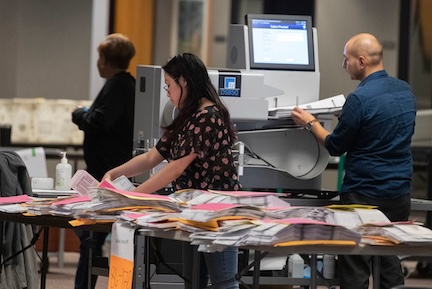
City of Milwaukee Election Commission workers process absentee ballots. (USA Today Network)
USPS ballot rule could affect state absentee voting
USA Today Network//June 11, 2026//


IN BRIEF
- USPS proposes requiring states to provide voter names and ballot barcodes for absentee voting.
- Wisconsin election officials warn the rule could delay ballot delivery in rural communities.
- The proposal follows unsuccessful federal efforts to obtain confidential Wisconsin voter information.
MADISON — The United States Postal Service is proposing a new rule that could require states to hand over some voter information to the Trump administration or risk losing delivery of mail-in ballots.
The proposed requirement released earlier this month may have implications for Wisconsin, where state election officials have successfully blocked a Trump administration effort to obtain personal information about voters, such as names, dates of birth, residential addresses, drivers’ license numbers and the last four digits of Social Security numbers.
The new proposed rule from the U.S. Postal Service requires states to provide the agency with the names and unique barcodes associated with each voter who is voting absentee. The Trump administration intends for the rule to be in place before the midterm election.
“This provision will help determine adherence to federal law and facilitate law enforcement efforts,” U.S.P.S. officials wrote in the proposed rule, which is not final until July and could change.
“For example, the provided lists will evidence how many ballots have been mailed and allow law enforcement officials to compare the total number of mailed ballots to the total number of received ballots to detect potential issues meriting further investigation.”
The proposed rule seeks to help enforce an executive order Trump issued earlier this year, which seeks to put federal control over voter rolls and mail-in ballots and requires the postal service to “not transmit mail-in or absentee ballots from any individual unless those individuals have been enrolled on a State-specific list.”
Wisconsin Elections Commission chairman Don Millis said the proposal would likely mean longer delays for voters in rural areas, where more Republican voters live.
The proposed rule requires absentee envelopes to include a barcode that is attached to each voter. But only two cities where Wisconsin mail is routed through have the ability to read these barcodes: Milwaukee and Minneapolis.
“If you’re close to it, the geography means your ballot’s going to get to the clerk much faster than if you’re in, say, Walworth County or Green Bay,” Millis said. “If you’re in Oconto, and you want to mail your ballot in, it’s going to go to Milwaukee to be processed and then returned back to Oconto, and that’s going to be even a greater delay than it is now.”
Millis said the rule affects only absentee ballots that are delivered to clerks by mail and is not related to absentee ballots cast in person before Election Day during a period known as early voting. He said because rural areas are less likely have ballot drop boxes, or are more likely to have fewer drop boxes, voters in those areas who want to ensure their ballots are counted will have fewer alternative to mailing them in.
“If the rule were to go into effect, I think the irony is that one of the biggest impacts is it would hurt Republicans incredibly,” Millis, a Republican, said in an interview.
In May, a federal judge dismissed a lawsuit from the U.S. Department of Justice that sought to gain access to confidential information of Wisconsin voters that state election officials argued is protected by Wisconsin law.
The federal lawsuit was one of more than two dozen the Trump administration has filed across the country against states with Democratic governors seeking those states’ voter lists without personal information redacted.
The U.S. Department of Justice, in its lawsuit, demanded the state’s unredacted list of voters, including the names, date of birth, residential address, drivers’ license numbers and the last four digits of Social Security numbers of every Wisconsin voter.
While the state’s voter lists are available to purchase, state law bars the release of such confidential information, according to the Wisconsin Elections Commission. Trump officials could purchase a copy of the state’s voter list that includes just names and addresses for $12,500.
It’s unclear if the U.S. Postal Service’s proposed rules would seek similar information or be limited to names.
Ann Jacobs, a Democratic member of the state elections commission, said the proposal would make election administrators out of the postal service without many regulations over how they would reject or accept ballots.
“All of a sudden, it becomes an election administrator deciding who’s worthy of voting, and that’s not their role, and it’s a dangerous role for them to be in,” Jacobs said.
“What is the remedy if they’re doing it wrong? What is the timeline? What if a small post office gets 5,000 ballots? What are they supposed to be doing with that? Do they get to take three days, four days, a week to process that? The entire thing is really just terrible.”
The NAACP last week filed a motion within a separate federal lawsuit seeking to block the proposal, asking the judge overseeing the case to issue a ruling by June 22.
Related Articles
Related Content




Polls
 Loading ...
Legal News
- Judge: Wisconsin absentee voting violates ADA
- Appeals court rules Enbridge Line 5 is trespassing
- Green Bay city clerk resigns amid absentee ballot scrutiny
- Former Epic employee sues over noncompete agreement
- Supreme Court approval remains below 50%, poll finds
- AI transforms family law but raises new legal concerns
- Illinois man gets prison for $1.2M employment tax fraud
Case Digests
- Termination of Parental Rights-Reasonable Efforts
- Family Law- Appellate Procedure
- Involuntary Administration of Medication-Mootness Exception
- Voluntary Consent to blood Draw- -Fourth Amendment
- Expert Testimony-Medical Malpractice
- Habeas Corpus-Bond Eligibility-Immigration Detention
- Fair Credit Reporting Act
- Copyright Infringement-Tortious Interference
- Tribal Land Trespass-Unjust Enrichment
- Fourth Amendment-Automobile Exception
- Age Discrimination in Employment Act-But For Causation
- Class-of One Equal Protection Claim-Breach of Contract
Legal Tech
- AI is reshaping family law practice, but attorneys worry about DIY research
- Massachusetts court rejects work product protection for AI documents by girlfriend
- Exterro launches on-premises AI platform for digital forensics
.png)