Free Newsletter

Wisconsin Supreme Court weighs judicial recusal rules
Sarah Lehr of Wisconsin Public Radio//June 5, 2026//
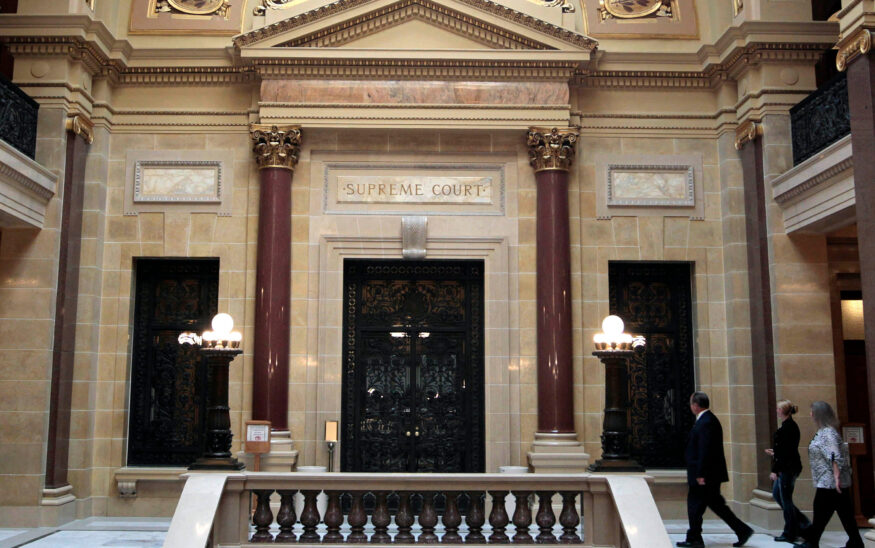
(USA Today Network)
Wisconsin Supreme Court weighs judicial recusal rules
Sarah Lehr of Wisconsin Public Radio//June 5, 2026//


IN BRIEF
- Wisconsin’s Supreme Court voted 5-2 to form a committee studying whether judges should recuse themselves when campaign contributions raise impartiality concerns.
- The 2025 Wisconsin Supreme Court race exceeded $100 million in spending, becoming the most expensive judicial election in U.S. history, with Elon Musk contributing at least $17 million.
- The proposed recusal rule leaves significant judicial discretion intact, with conservative Justice Brian Hagedorn calling it “PR cover” that doesn’t substantively change existing standards.
When should judges step away from a case because of a conflict of interest?
Wisconsin’s Supreme Court is weighing changes to those rules — including a proposal that would urge judges to consider recusing themselves because of campaign contributions.
On Thursday, the state’s highest court voted 5-2 to assign a committee to study the issue further.
That action came in response to a proposal from a group of retired circuit court judges. That includes former Dane County Judge Richard Niess, who spoke about the proposal during a public hearing Thursday.
“The problem we are trying to resolve, in part, is the public perception that … the court can be for sale,” Niess said.
If changes are adopted, they could potentially apply to justices on the state’s highest court themselves, as well to appellate, circuit and municipal judges hearing cases throughout Wisconsin.
Although Wisconsin Supreme Court seats are officially non-partisan, the state’s recent high court elections have attracted massive spending, including from political parties and other political interest groups.
In 2025, more than $100 million in donations poured into Wisconsin’s Supreme Court race, making that contest the most expensive judicial election in U.S. history. The largest individual contributor to that race was President Donald Trump’s former advisor Elon Musk, who gave at least $17 million to support conservative Brad Schimel. Schimel lost to liberal Justice Susan Crawford.
If Schimel had been elected to the court, that may have posed an issue if he chose to hear a case related to Musk or Musk’s businesses, Niess suggested.
“There would have been a real question that would have had to have been answered,” Niess said during the hearing. “But these are issues that the committee, I think, can bat around.”
Total spending on the 2025 Supreme Court race beat a previous spending record from the state’s 2023 election when liberal Justice Janet Protasiewicz beat conservative Daniel Kelley.
Under the recently introduced proposal, judges would be urged to recuse themselves whenever a campaign contribution raises a “reasonable question” about a “judge’s ability to be impartial.”
That proposed language doesn’t specify how big a donation needs to be in order to trigger recusal. In effect, that still leaves judges with a lot of discretion about whether or not to recuse, conservative Justice Brian Hagedorn said.
“I’m not sure it’s tightening much of anything,” Hagedorn said. “A lot of this feels like PR cover to me, that doesn’t really do anything.”
Hagedorn ultimately agreed to create the study committee. The court’s other two conservative justices — Anette Ziegler and Rebecca Bradley — voted against.
“The court, as currently constituted, will never adopt anything that will interfere with the successful formula for electoral success in recent elections, which is to telegraph how you will rule on cases,” Bradley said.
Wisconsin’s high court currently has a four to three liberal majority.
The court’s most recently elected justices — Crawford and Protasiewicz —campaigned while highlighting their support for abortion rights and other issues. That prompted criticism from Bradley and other conservatives, who accused them of eroding the court’s impartiality.
Several conservative justices suggested that the proposed rule changes don’t go far enough to urge recusal based on a judge’s past public statements.
Niess responded by saying that if judges express their opinions on a broad political or legal topic, that’s not the same as stating how they would rule in a specific case.
“For better or for worse, the judges in this state are elected,” Niess said. “The electorate needs to be fully informed about what the past positions of the candidates have been on all issues.”
Ziegler countered by suggesting that’s she’s been troubled how often justices have been airing their political leanings during recent campaigns.
“My personal opinion is not relevant to the decisions that I reach,” Ziegler said. “They might be interesting (and) a hot topic that the public feels strongly about. That might get you elected, but that is not what the judiciary is supposed to be doing.”
The Wisconsin Association for Justice, which represents the interests of trial lawyers, said it supported creating a committee to study the issue, although the group opposes the proposed amendments in their current form.
Specifically, the group took issue with the proposal recommending that judges recuse themselves because of certain campaign contributions.
Those changes could have a “chilling effect on political speech,” Wisconsin Association of Justice President Danielle Schroder warned.
Wisconsin Association of Justice’s past President Ann Jacobs said the definition of “contribution” in the proposed rules could be broad enough to include not just monetary donations — but also actions like knocking on doors, making phone calls or posting on social media to support a candidate.
Jacobs is a Democrat who also serves as president of the Wisconsin Elections Commission.
“We must be extraordinarily careful not to penalize lawyers and litigants for being politically active,” Jacobs said. “That’s the heart of our democracy.”
Additionally, the Association for Justice argued that many of the proposed rule changes are overly broad, making it hard for judges to comply on a practical level. Issues could arise when judges receive money from a committee that obscures its individual funders.
“It requires judges to develop knowledge of contributions to political action committees or other groups for which there’s no mechanism for tracing,” said Brad Yanke with the Wisconsin Association for Justice. “Often the money is pooled, and it’s not clear how the organization allocated funding.”
Wisconsin’s existing rules for judicial recusal were adopted when the high court had a conservative majority in 2010, based on a draft created by Wisconsin Manufacturers and Commerce and the Wisconsin Realtors Association.
The court’s current liberal majority is poised to grow even further when Justice-Elect Chris Taylor is sworn in on Aug. 1, replacing Bradley, who opted not to run for reelection. Taylor won a race against conservative Appeals Judge Maria Lazar in April.
Related Articles
Related Content




Polls
 Loading ...
Legal News
- Lawsuit challenges Wisconsin transgender birth certificate law
- Ex-Milwaukee Tool worker sentenced for $1M theft
- Musk election complaints sent to La Crosse DA
- Immigrant children face loss of legal aid in Wisconsin
- Judge: Wisconsin absentee voting violates ADA
- Appeals court rules Enbridge Line 5 is trespassing
- Green Bay city clerk resigns amid absentee ballot scrutiny
Case Digests
- Expert Testimony-Evidentiary Sufficiency
- Sixth Amendment-Speedy Trial Prejudice
- Reasonable Suspicion-Expanded Traffic Stop
- Tribal Sovereign Immunity-Indispensable Party
- Probable Cause-K-9 Stop Extension
- Prosecutorial Misconduct-Burden Shifting-Sexual Assault
- Jury Instructions-Harmless Error
- Evidence-Protective Search
- Fraud-Fifth Amendment-Sixth Amendment
- Multiple Bribes Enhancement-Loss Amount Calculation-Wire Fraud
- Protected Service Rights-Water Service Made Available
- First Amendment-Fourteenth Amendment-Viewpoint Discrimination in a Public Forum
Legal Tech
- The billable hour is not dead, but AI is chipping away at its prevalence
- NYC Bar provides roadmap for navigating AI privilege issues
- Litify launches AI tool to automate personal injury demand preparation
Legal Tech Directory
BridgeTower connects 640K legal professionals with leading technology and service providers nationwide.


.png)