Free Newsletter

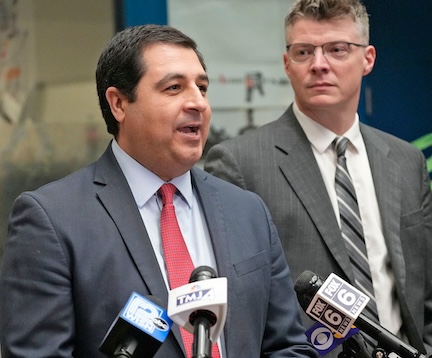
Wisconsin Attorney General, Josh Kaul, left,is suing behemoth prediction markets Kalshi, Coinbase, Polymarket and others, alleging they are running illegal gambling schemes in Wisconsin. (USA Today Network file photo)
Wisconsin sues prediction markets over illegal gambling
USA Today Network//April 24, 2026//


IN BRIEF
- Wisconsin AG Josh Kaul is suing Kalshi, Coinbase, Polymarket and others.
- Lawsuits allege “event contracts” are illegal sports betting schemes.
- Case comes as Wisconsin moves toward limited legalized online betting through tribes.
MADISON — Attorney General Josh Kaul is suing behemoth prediction markets Kalshi, Coinbase, Polymarket and others, alleging they are running illegal gambling schemes in Wisconsin.
Kaul plans to file three separate lawsuits in Dane County Circuit Court against prediction market companies, alleging they are bypassing state laws by characterizing sports bets as “event contracts.”
“Sports betting and other forms of commercial gambling have long been illegal in the state of Wisconsin. No company is above this law no matter how creatively those companies try to disguise the activity they’re engaged in,” Kaul said in a virtual news conference with reporters on April 23.
“Our position in this case is that event contracts are no different than ordinary sports bets,” he said. “The companies collect a fee, we allege, for every bet that’s made, leading them to earn significant revenue from Wisconsinites through violations of our state’s gambling regulations.”
Kaul said the state is asking the judge overseeing the case to declare such gambling a violation of the law and to be banned in the state. Kaul is not seeking monetary damages.
A spokesperson for one of the named companies, Robinhood, said in a statement that the company’s “event contracts” are federally regulated and allow customers to “access prediction markets in a safe, compliant, and regulated manner.”
“We intend to defend ourselves against these claims.”
Representatives of the other companies named in the lawsuits did not immediately respond to requests for comment.
The lawsuits will be filed just two weeks after Gov. Tony Evers signed into law a measure that paves the way for online sports betting in the state but requires such gambling to be carried out only through the state’s 11 tribal nations. Kaul said Thursday the new law had no bearing on his decision to file the lawsuit.
The new law adds an exception to the state’s legal definition of “bet” to allow wagers placed on a mobile or electronic device by a person located in Wisconsin, as long as the service or device processing the bet is located on in-state tribal lands and otherwise follows the state’s gaming compacts.
Under the new law, the state’s Native American tribes may take the next step toward bringing legal online betting to Wisconsin by renegotiating the state’s gaming compacts.
In the early 1990s, the state established gaming compacts with all 11 federally recognized tribes in Wisconsin, giving the tribes the exclusive rights to conduct certain gambling operations while sending a percentage of that revenue back to the state.
The state primarily uses those funds for specific purposes, including economic development efforts, local services and tourism promotion in areas where the tribes are located.
Tribes can expand their gaming offerings by renegotiating those compacts with the governor, and the federal Bureau of Indian Affairs must approve.
Recent amendments to those compacts, negotiated with Evers, have allowed the Oneida Nation, Forest County Potawatomi and Ho-Chunk Nation to offer on-site sports betting. Under current law, it’s legal in Wisconsin to place a sports bet at a casino, but not from home on an app run by the casino.
The new law lays out a “hub and spoke” model – with the “hub” being a server located on tribal land and the “spokes” being the users throughout the state. It follows a recent federal court case allowing the Seminole Nation to similarly operate an online sports betting system in Florida.
The effort faced pushback from national companies DraftKings and FanDuel, anti-gambling advocates and the conservative Wisconsin Institute for Law & Liberty, which argues it raises constitutional issues.
Under the federal Indian Regulatory Gaming Act, 60% of tribally operated gross gaming revenue must go back to the tribes – a revenue split the national companies say isn’t worth the cost of doing business in a market the size of Wisconsin.
Related Articles
Related Content





Polls
 Loading ...
Legal Tech
- How ransomware tactics against law firms are changing
- How large language models are leveling the personal injury playing field
- Attorney Share, Lawmatics integrate to automate law firm referrals
Legal News
- State Democrats challenge absentee ballot rule
- Prediction market warning sparks legal dispute
- Leadership key to successful AI adoption in the workplace
- Third defendant in Marshfield ATM ‘jackpotting’ theft gets probation
- Elections commission warns betting could cost Wisconsin voters
- State warns of workers’ compensation scam targeting victims
- Milwaukee defends ICE mask ban against DOJ challenge
Case Digests
- Informed Consent-Statutory Standing
- Zoning and Property Rights-Rental Restrictions
- Ineffective Assistance of Counsel-Evidence Omission
- Plain Error-Ineffective Assistance of Counsel
- Revocation Sentencing -Sentencing Factors
- Tax Claim Classification-Tax Sale Claims
- Race Discrimination-Employment Retaliation
- First Amendment-Pickering Balancing Test
- Procedural Reasonableness-Federal Sentencing Discretion
- Federal Officer Removal Statute-Climate Change Litigation
- Telephone Consumer Protection Act-Class Action
- Age Discrimination Employment Act-Sufficiency of Evidence