Free Newsletter

Milwaukee joins fire truck price-fixing lawsuit
Kelli Arseneau of USA Today Network//February 27, 2026//
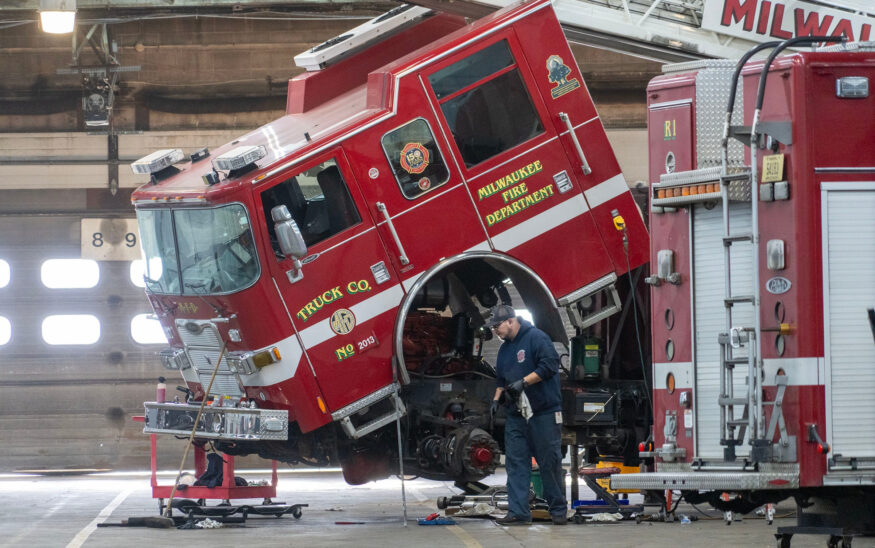
Alex Gruszka, a fire apparatus technician, works on a fire truck at a Milwaukee Fire Department vehicle repair facility on West Fiebrantz Avenue in Milwaukee, Wisconsin on Nov. 3, 2025. (USA Today Network file photo)
Milwaukee joins fire truck price-fixing lawsuit
Kelli Arseneau of USA Today Network//February 27, 2026//


 Listen to this article
IN BRIEF
- City of Milwaukee filed suit alleging fire truck price-fixing and anticompetitive conduct.
- Lawsuit targets REV Group, Oshkosh Corp. and Rosenbauer America.
- Case may join La Crosse-led federal class action over inflated firefighting equipment costs.
The City of Milwaukee has filed a new lawsuit, which may become part of an ongoing federal class action lawsuit, accusing three fire truck manufacturers of colluding to drive up the price of firefighting equipment.
The class action lawsuit was first filed by the City of La Crosse in August 2025. It accuses three companies – REV Group, Oshkosh Corp. and Rosenbauer America – of illegally working together to limit the supply and drive up the price of fire trucks, through the facilitation of the nonprofit Fire Apparatus Manufacturers’ Association.
Two of those companies are headquartered in Wisconsin: Oshkosh Corp. – and its subsidiary Pierce Manufacturing – in the Fox Valley, and REV Group in Brookfield.
According to court records, municipalities across the country have since made efforts to join the class action lawsuit.
Milwaukee’s lawsuit was filed Feb. 18. City Attorney Evan Goyke said in a statement that Milwaukee invests taxpayer dollars into equipment that saves lives of residents every day, and that the equipment has spiked in price over the past decade, as a result of “an unlawful anticompetitive scheme.”
“When public entities are forced to pay inflated prices for essential emergency equipment, taxpayers bear the cost,” Goyke’s statement says. “We join the growing number of local governments that have filed suit as we attempt to ensure that the Milwaukee Fire Department can continue to provide vital services, and to protect the taxpayers of the City of Milwaukee. Local governments are entitled to fair competition when purchasing essential public safety equipment.”
The lawsuits allege that prices of fire trucks have skyrocketed since the mid-2010s. The higher prices, combined with long wait times on orders, have left many fire departments with aging fleets, which is a public safety concern, fire departments say.
The Milwaukee Fire Department has dealt with aging equipment – some of its fire trucks being used well beyond their 15-20 year lifespan – for a long time. In recent years, the department’s budget requests to update its equipment have not been met by the city budget, but in the 2026 budget, city council members overrode a mayoral veto to increase the fire department’s funding to $10 million.
Milwaukee Fire Chief Aaron Lipski declined to comment about the city’s lawsuit.
Tim Gilman, a spokesperson for Oshkosh Corp., previously told the Milwaukee Journal Sentinel that the company denies the lawsuit’s claims.
“The allegations in this lawsuit are without merit, and Oshkosh remains committed to delivering safe, high-quality fire trucks while continuing to reinvest in our U.S. operations to meet record demand,” Gilman said in a statement.
South Dakota-based Rosenbauer America also issued a statement disputing the allegations.
“We strongly disagree with the claims made in these lawsuits, and Rosenbauer America will assertively defend itself,” the company’s legal counsel, Ali Rader, said in a statement. “Rosenbauer America will not let this distract from doing what we do best – supporting first responders and those they keep safe by delivering cutting-edge firefighting and rescue technology and equipment communities rely on.”
Spokespeople for REV Group and FAMA didn’t respond to a request for comment.
Milwaukee’s lawsuit complaint mirrors much of the complaint filed in the La Crosse-led class action lawsuit.
Both complaints briefly describe the history of the United States’ fire truck industry, specifically how it was diverse and comprised of numerous independent sellers until around 2008, when the Great Recession hit.
At that point, the number of fire trucks ordered annually in the United States cut in half, from around 6,000 to 3,000, causing many independent fire truck manufacturers to go out of business, Milwaukee’s complaint says.
In 2015, a private equity firm, American Industrial Partners, created REV Group from the merger of several fire truck manufacturing companies. Around 2016, as state and local budgets rebounded from the Great Recession, demand for fire trucks again increased to around 4,000 or 5,000 annual orders in the United States. REV Group began making money and further consolidating the fire truck industry, the complaints say.
This consolidation “has significantly decreased competition across the fire truck manufacturing industry, to the detriment of consumers of public safety,” Milwaukee’s lawsuit complaint says.
In 2021 and 2022, Oshkosh Corp. made two major acquisitions that led it to gain control of 25% of the U.S. fire truck market; its leading North American company, Pierce, acquired Boise Mobile Equipment. Then Oshkosh Corp. acquired Canadian firetruck manufacturer Maxi-Metal.
The company also “took steps to eliminate competition among its subsidiaries by consolidating its U.S. brands and reducing geographic overlap between dealers” between 2018 and 2025, the complaint of the Milwaukee lawsuit says.
Following the lead of the other two companies, Rosenbauer America also made efforts to consolidate, the lawsuit complaints allege. In 2023, the company partnered with IKON Fire to expand its network of truck dealers into Colorado and Wyoming. Its dealers also have non-overlapping territories, which reduces competition, according to the complaints.
The lawsuits allege that REV Group, Oshkosh Corp. and Rosenbauer America not only halted competition between their own brands, but also began cooperating with each other.
The cooperation was facilitated by the Fire Apparatus Manufacturer’s Association, known as FAMA, the lawsuits claim.
Companies that are members of FAMA submit non-public economic data. The trade association then shares that data with an outside consulting company, which compiles it into reports that FAMA provides only to its members, according to the lawsuit complaints.
Rosenbauer America, as well as REV Group-owned brands E-One, KME and Ferrara and the Oshkosh Corp.-owned brand Pierce, are all FAMA members, the complaints say.
Beginning in the mid-2010s, demand for fire trucks steadily increased for the first time since the 2008 recession. Then a spike in orders across the country came between 2020 and 2022, due to municipalities’ COVID relief funds.
The lawsuits say REV Group, Oshkosh Corp. and Rosenbauer America have not kept up with the increased demand and have multi-billion-dollar backlogs.
Despite this, the manufacturers “have taken no steps to meaningfully expand their manufacturing capacity,” Milwaukee’s lawsuit complaint says.
As a result, municipalities are left relying on their aging equipment when orders have long wait times. According to the Milwaukee lawsuit complaint, three REV fire engines the city purchased for more than $1 million each in January 2025, and two REV ladder trucks purchased in June 2025 for around $1.9 million each, have never been delivered.
Additionally, the lawsuits say the three manufacturers have imposed “floating prices” that add costs after a truck is ordered, because of the difficulty to project material costs over the multi-year wait for a new truck.
Related Articles
Related Content






Polls
 Loading ...
Legal News
- WILL challenges Wisconsin signature-gathering ban
- Madison voters sue over rejected absentee ballots
- Former Judge Hannah Dugan renews bid to overturn verdict
- Sheboygan Falls mom stays in ICE custody
- Milwaukee woman charged in $2M Medicaid fraud case
- Evers sues Joint Finance Committee over DOJ powers
- Central Wisconsin drug trafficking ring sentences handed down
- Immigration lawyer seeks release of Sheboygan Falls woman
- Wausau attorney pleads not guilty to intimidation charges
- Appeals court ruling could affect abortion pill access
- Wisconsin DOJ adds device-sniffing dog to fight exploitation
- Supreme Court to hear hospital tax exemption case
Case Digests
- Breach of Agreement-Mootness-Tax Assessment
- Domestic Abuse-Ineffective Assistance of Counsel (Subsequent Counsel)-Intimidation
- Deferred Judgment Agreement-Compliance Determination
- Marital Settlement-Child Support Conversion
- Factors Supporting Reasonable Suspicion -Act 79 Searches
- Statutory Notice Requirements -Immigration
- Controlled Substances Act-Jury Instructions
- Abuse of Discretion Standard-Exceptional Circumstances-Immigration
- Americans with Disabilities Act-Equitable Tolling-Retaliation
- Sufficiency of Evidence-Jury Instructions-Federal Program Bribery
- Sentencing Discretion-Clear Error Review
- Sentencing Guidelines-Sentence Enhancements-Fraud