Free Newsletter

Prosecutors oppose Hannah Dugan bid to overturn verdict
John Diedrich of USA Today Network//February 23, 2026//
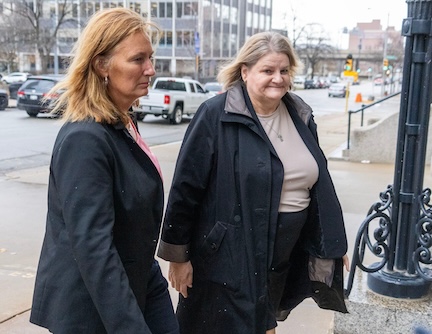
Judge Hannah Dugan (right) enters the Milwaukee Federal Building and U.S. Courthouse in Milwaukee, Wisconsin on Nov. 26, 2025. (Mike De Sisti / USA Today Network)
Prosecutors oppose Hannah Dugan bid to overturn verdict
John Diedrich of USA Today Network//February 23, 2026//


 Listen to this article
IN BRIEF
- Prosecutors call Hannah Dugan‘s bid to overturn her guilty verdict “absurd.”
- Jury convicted the former Milwaukee County judge of obstructing federal immigration agents.
- Defense argues judicial immunity and improper jury instruction; prosecutors dispute both claims.
Federal prosecutors have labeled an effort by former Milwaukee County Circuit Judge Hannah Dugan to overturn the jury’s guilty verdict against her as “absurd” and urged a judge to reject it.
Prosecutors wrote in a 45-page response that overturning a jury’s verdict is reserved for extreme circumstances under federal law and Dugan’s team failed to make that case in their earlier motion.
A federal jury found Dugan guilty of obstructing federal immigration agents, a felony, on Dec. 18. The jury found her not guilty on a misdemeanor charge of concealing an undocumented immigrant that agents were seeking to arrest.
“The trial evidence was sufficient to allow a rational juror to convict Dugan” on the felony count, prosecutors wrote in the Feb. 20 response.
The case thrust Dugan to the forefront of the clash between the judiciary and the Trump administration as it executes a sweeping immigration crackdown nationwide.
On Jan. 30, Dugan’s legal team filed a motion to overturn the verdict against her, arguing immigration agents were not allowed to make arrests in the courthouse and judges are immune from such prosecution.
Dugan is “the first American judge ever to face trial and a guilty verdict on a felony charge for acts that all were ‘part of a judge’s job,'” her attorneys wrote in their 46-page motion.
Dugan’s team also argued U.S. District Judge Lynn Adelman gave an incorrect answer to a jury question. If Adelman denies the motion to outright overturn the verdict, the team is asking the judge to order a new trial.
Prosecutors assailed each argument by Dugan’s team, saying her attorneys were wrong about agents’ authority to make civil immigration arrests in courthouses. They also said Adelman answered the jury question properly and Dugan was not immune from prosecution.
“Nothing in that statute or in the cases cited by Dugan authorizes a Wisconsin judge to interfere with the enforcement of federal immigration law, provided she does so using the means at her disposal by virtue of her position,” prosecutors wrote.
“Dugan’s claim that she had the right ‘to take multiple legal steps, regardless of motive’ is absurd.”
Dugan’s team has until March 6 to respond. Adelman, who denied the defense’s judicial immunity claim to dismiss the case before the trial, is expected to rule on the motion after that.
Regardless of how Adelman rules, it seems likely the Dugan case will end up at the 7th Circuit Court of Appeals and possibly the U.S. Supreme Court.
Dugan, 66, resigned from the bench on Jan. 3, as an effort to impeach her and remove her from the bench was mounting within the Republican-controlled state Legislature.
During the criminal case, Dugan had been suspended with pay, continuing to receive her roughly $175,000 annual salary. A fundraiser was started to pay for Dugan’s defense team.
A judge for nine years, Dugan faces up to five years in prison, but it is unlikely she would get time behind bars. For a defendant with no criminal history who is convicted of a nonviolent crime, federal sentencing guidelines generally call for probation.
In an unusual move, Adelman did not set a sentencing date or order a pre-sentence investigation after the jury delivered the verdict. Adelman signaled he would hold off on doing that while the defense filed its motion.
Dugan was charged with trying to help Eduardo Flores-Ruiz, an undocumented immigrant from Mexico, elude a U.S. Immigration and Customs Enforcement arrest team on April 18, 2025.
Flores-Ruiz, 31, was appearing before Dugan on misdemeanor battery charges. He had illegally re-entered the U.S. after being deported in 2013. Six agents were waiting in the hallway to arrest him after his appearance before Dugan.
Dugan and another judge went into the public corridor, questioned the agents and directed them to the chief judge’s office. Dugan returned to her courtroom, called Flores-Ruiz’s case, and then led him and his lawyer into a hallway reserved for staff and jurors.
Dugan’s court reporter offered to show the pair out the private hallway, but Dugan responded, “I’ll do it. I’ll get the heat.”
Flores-Ruiz and his attorney emerged in the public corridor. Two agents followed. Flores-Ruiz was arrested outside after a short foot chase.
Dugan’s attorneys have noted Flores-Ruiz was arrested anyway. But prosecutors said Dugan turned what should have been a simple arrest into a volatile situation.
“There is a stark difference between the planned low-key arrest of Flores-Ruiz by the entire Task Force team following his court appearance and an arrest outside of the courthouse following a foot chase through moving traffic by only a portion of the team,” prosecutors wrote.
“Here, the evidence established that Dugan was actually successful in her endeavor to obstruct and impede the agents.”
Related Articles
Related Content





Polls
 Loading ...
Legal News
- Officials worry about USPS speed with ballot delivery
- Judge: Ex-Milwaukee teacher’s aide can return to U.S.
- Ex-bank manager sentenced for $350K embezzlement
- Dugan sentencing delayed for oral arguments
- Wisconsin women’s prisons 78% over capacity, nearing record
- Milwaukee prenatal nonprofit founder to plead guilty to fraud
- Wisconsin DOJ takes years to fulfill public records requests
- Wisconsin sheriffs appeal ICE detention lawsuit
- Organic dairy brands sue over federal milk pricing rules
- Sheboygan Falls mom released from ICE detention
- Wisconsin courts need more judges, workload study finds
- FBI to interview Milwaukee police in Wisconsin 2020 election probe
Case Digests
- Involuntary Commitment-Waiver of Rights
- Contractual Discretion-Appellate Forfeiture-Raffle Statutes
- Standing -Zoning Variance
- Strickland Standard-Sentencing Discretion
- Sixth Amendment-Harmless Error
- Harassment Injunction-Social Media Evidence
- Termination of Parental Rights-Evidentiary Sufficiency
- Termination of Parental Rights-Reasonable Efforts
- Special Condition 13-Issue Preservation
- Right of Publicity Act-Defamation
- Plea Withdrawal-Witness Recantation-
- Election Fraud-Official Misconduct