Free Newsletter

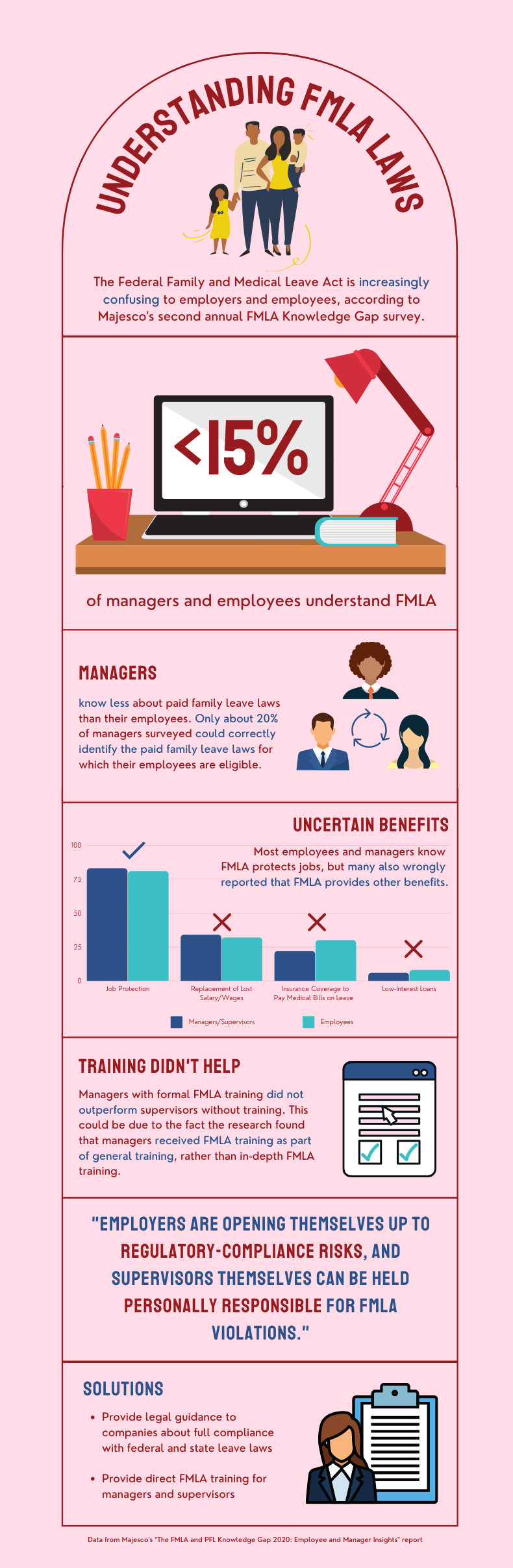
Report: Fewer than 15% of managers, employees understand FMLA laws (INFOGRAPHIC)
Fewer than 15% of managers and employees understand Family and Medical Leave Act laws, according to a recent report based on 2020 survey results. The second annual “The FMLA and PFL Knowledge Gap 2020: Employee and Manager Insights” report from Majesco compiled survey results from more than 1,000 participants working for businesses with anywhere from 100 […]
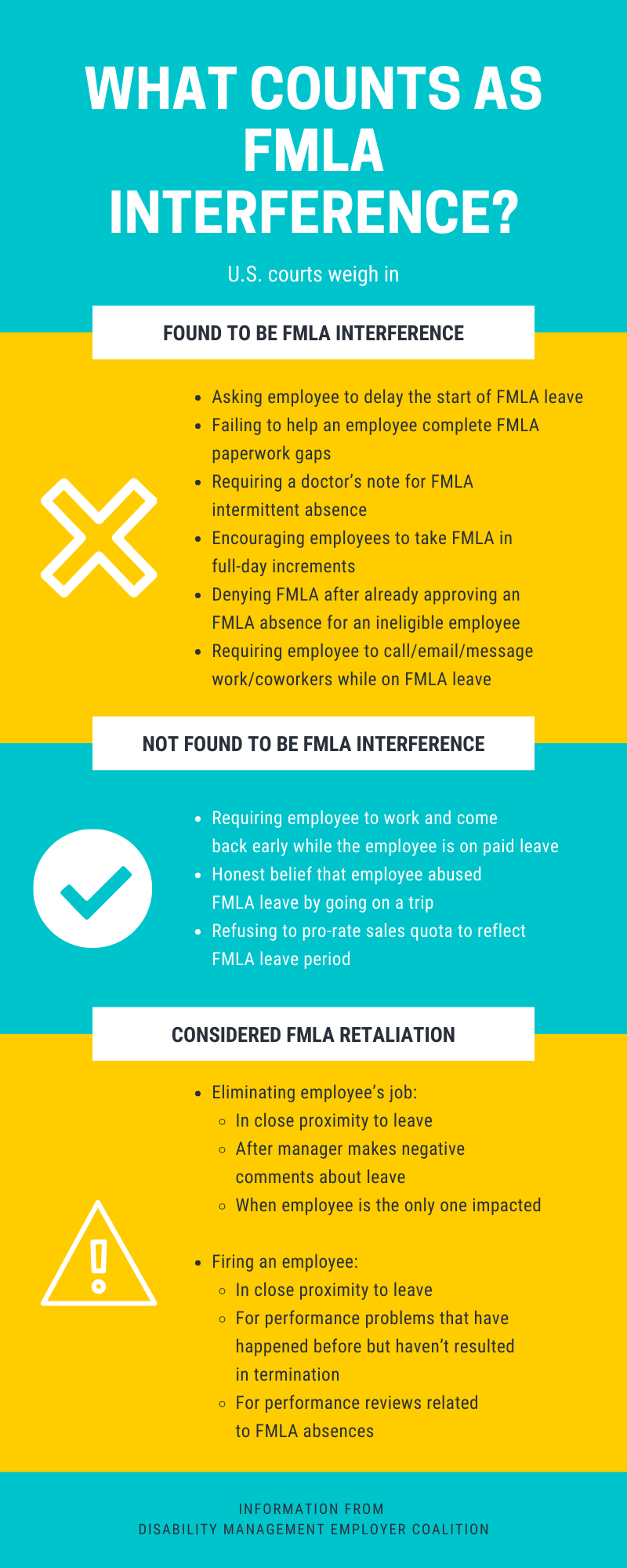
What US courts consider employer FMLA interference (INFOGRAPHIC)
Courts across the U.S. ruled in dozens of cases dealing with Family and Medical Leave Act labor laws over the past 12 months, and Marjory Robertson, assistant vice president and senior counsel at Sun Life Insurance, said she’s read the decision in every one.

Best practices for working with victims of human trafficking (INFOGRAPHIC)
The American Bar Association started the Survivor Reentry Project to provide national training and assistance for attorneys working with trafficking survivors seeking criminal record relief.
You can (sometimes) use social media as proof of FMLA abuse in court (INFOGRAPHIC)
A Facebook photo surfaces showing an employee who’s using leave under the Family and Medical Leave Act relaxing on the beach. The photo can be used as proof of FMLA abuse in court — depending on the circumstances.
Lawmaker proposes organ donation leave of absence (UPDATE)
A state senator whose husband died while waiting for a transplant is proposing legislation requiring Wisconsin employers to allow unpaid leave for donating an organ.
Proposed FMLA regulation would require benefits for same-sex couples
A proposed federal regulation requiring employers to provide legally-married same-sex couples with benefits under the Family and Medical Leave Act regardless of their employees' state of residence could help clear up some complications caused by conflicting federal and state laws.
Ex-Caterpillar employee sues company
A former Caterpillar employee is suing the company, claiming he was fired illegally after his doctor checked the wrong box on a medical report.
Employers brace for in-person investigations over FMLA
All in attendance sat up and took notice when midway through a three-day conference on employment compliance, a branch chief of the U.S. Department of Labor’s enforcement division said that the agency expects to increase on-site investigations into whether companies are complying with the Family and Medical Leave Act.
JOB CITES: Don’t be fooled: Labor laws apply to nonunion employers
 Consider the following scenario: You are a nonunion employer who has just conducted an internal investigation into a harassment complaint by an employee (let’s call her Monica).
The role of counsel in executive terminations
Say a client informs you that an executive may be discharged, and asks for advice. The executive’s high salary and superior communication skills would make this a relatively dangerous termination.
Employers push back on FMLA abuse
In an effort to root out employee abuse of Family and Medical Leave Act violations, employers are increasingly relying upon the “honest suspicion” defense – and winning.
Polls
 Loading ...
Legal News
- The Latest: Supreme Court arguments conclude in Trump immunity case
- Net neutrality restored as FCC votes to regulate internet providers
- Wisconsin Attorney General asks Congress to expand reproductive health services
- Attorney General Kaul releases update at three-year anniversary of clergy and faith leader abuse initiative
- State Bar leaders remain deeply divided over special purpose trust
- Former Wisconsin college chancellor fired over porn career is fighting to keep his faculty post
- Pecker says he pledged to be Trump campaign’s ‘eyes and ears’ during 2016 race
- A conservative quest to limit diversity programs gains momentum in states
- Wisconsin prison inmate pleads not guilty to killing cellmate
- Waukesha man sentenced to 30 years for Sex Trafficking
- 12-year-old shot in Milwaukee Wednesday with ‘serious injuries’
- Milwaukee man convicted of laundering proceeds of business email compromise fraud schemes
WLJ People
- Power 30 Personal Injury Attorneys – Russell Nicolet
- Power 30 Personal Injury Attorneys – Benjamin Nicolet
- Power 30 Personal Injury Attorneys – Dustin T. Woehl
- Power 30 Personal Injury Attorneys – Katherine Metzger
- Power 30 Personal Injury Attorneys – Joseph Ryan
- Power 30 Personal Injury Attorneys – James M. Ryan
- Power 30 Personal Injury Attorneys – Dana Wachs
- Power 30 Personal Injury Attorneys – Mark L. Thomsen
- Power 30 Personal Injury Attorneys – Matthew Lein
- Power 30 Personal Injury Attorneys – Jeffrey A. Pitman
- Power 30 Personal Injury Attorneys – William Pemberton
- Power 30 Personal Injury Attorneys – Howard S. Sicula